The hospitality industry has spent much of the past two decades adapting to one technological disruption after another. First came online travel agencies, followed by review platforms, social media, mobile booking systems, and increasingly sophisticated revenue management tools. Now a new concern is spreading through hotel boardrooms and industry conferences: artificial intelligence. A recent industry paper from the American Hotel & Lodging Association and HTNG argues that hotels must prepare for a future in which AI systems become a primary channel through which travelers discover, evaluate, and book accommodations. The concern is understandable, and much of the diagnosis is correct. The proposed solution, however, may miss the larger transformation already underway.
At first glance, the challenge appears largely technical. Hotels must ensure that their rates, availability, descriptions, amenities, and booking capabilities are accessible to AI systems through structured data and modern interfaces. The paper focuses heavily on standards, interoperability, content architecture, and the need for hotels to remain visible within emerging AI ecosystems. Beneath the technical language, however, lies a familiar anxiety. The hospitality industry remembers what happened when online travel agencies emerged and gradually inserted themselves between hotels and their guests. Many properties surrendered direct relationships in exchange for visibility, only to discover later that the intermediaries had become some of the most powerful players in travel. Today, many hoteliers fear that AI agents may become the next generation of gatekeepers.
That concern is entirely reasonable, but it may also reflect an outdated understanding of where the technology is heading. Much of the current discussion assumes a future in which travelers ask an AI system for recommendations, and the AI simply acts as a more sophisticated booking intermediary. The model remains essentially unchanged: guest, intermediary, hotel. The industry’s objective, therefore, becomes ensuring that the intermediary has access to accurate information.
What if that is not the real revolution?
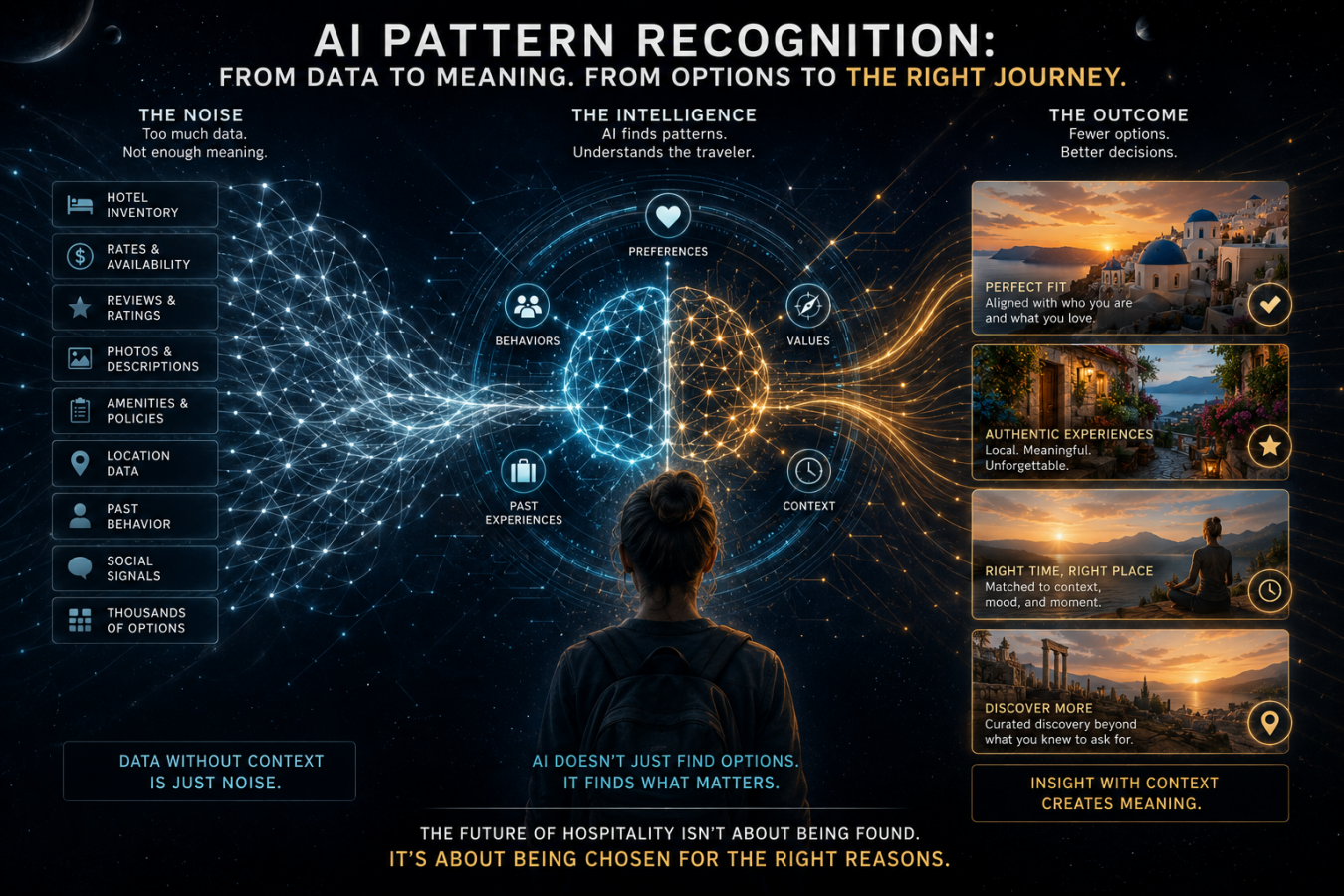
Technology writer Kevin Kelly argued years ago that the central challenge of the digital age would not be obtaining information but filtering it. As information becomes abundant, value shifts toward systems capable of identifying what is personally relevant. Artificial intelligence may represent the ultimate realization of that principle. Rather than functioning as another distribution channel, intelligent travel agents could act as sophisticated filters, evaluating thousands of options and narrowing them to those most aligned with an individual traveler’s preferences, values, and goals.
The more profound shift may occur when artificial intelligence ceases to act primarily on behalf of suppliers and begins acting on behalf of travelers. In that world, the center of the travel ecosystem is no longer the hotel, the online travel agency, or even the AI platform itself. The center becomes the individual traveler and the accumulated knowledge an intelligent system has about their preferences, habits, experiences, and aspirations. As technology thinker Doc Searls argued through Project VRM and the concept of the ‘intention economy,’ the customer increasingly becomes the point of integration rather than the supplier.
Imagine a traveler planning a trip to Crete. Traditional systems focus on inventory, rates, room categories, and availability. A truly intelligent travel assistant might begin somewhere entirely different. It might already know that the traveler dislikes crowded resorts, prefers family-run accommodations, enjoys local tavernas, seeks historical sites, values silence more than nightlife, and would rather spend an afternoon walking through an abandoned village than sitting beside a hotel pool. Such a system would not merely search for rooms. It would search for experiences that align with the traveler as a person.
This distinction may sound subtle, but it changes everything. For decades, hospitality technology has been designed primarily to optimize transactions. Artificial intelligence has the potential to optimize outcomes. The traveler is no longer asking, “What room should I book?” The traveler is asking, “Where will I be happiest?” Those are very different questions, and they require very different forms of intelligence.
The industry paper correctly identifies the importance of visibility within AI systems, but visibility alone has never been hospitality’s greatest challenge. The true challenge has always been trust. Travelers do not ultimately care whether a hotel’s content is perfectly structured or whether its inventory feed updates every few seconds. They care whether the reality matches the promise. They care whether the beach resembles the photographs, whether the service reflects the reviews, whether the destination feels authentic, and whether the experience justifies the investment of both time and money.
Artificial intelligence may actually make these questions more important rather than less. As AI systems become increasingly capable of identifying patterns, comparing experiences, and evaluating outcomes, they may become less susceptible to marketing language and more focused on evidence. The industry’s longstanding reliance on branding, loyalty programs, advertising placement, and carefully crafted promotional messaging could become less influential than genuine guest satisfaction and demonstrated performance.
This possibility creates a challenge that many hospitality executives have yet to fully appreciate. Much of the current conversation remains focused on controlling distribution, preserving visibility, and protecting direct booking channels. These concerns are understandable, but they assume that the primary battle remains one of access. The more significant battle may be one of credibility. An intelligent system that genuinely understands its user will not necessarily recommend the property with the strongest marketing budget or the most sophisticated booking engine. It may recommend the property that consistently delivers the experience the traveler is most likely to value.
The industry’s growing fascination with technologies such as MCP, structured content, and AI interoperability is therefore both important and incomplete. These systems represent infrastructure. They are the pipes through which information flows. Yet history repeatedly demonstrates that infrastructure alone rarely determines outcomes. What matters is the quality, relevance, and trustworthiness of the information moving through those channels.
Perhaps the greatest blind spot in many hospitality AI discussions is the assumption that technology will primarily strengthen existing industry structures. It may do precisely the opposite. The most powerful AI systems may ultimately weaken traditional intermediaries, reduce the influence of marketing, and shift decision-making power toward individual travelers. In such an environment, the winners may not be the organizations with the most sophisticated distribution architecture, but those that consistently deliver authentic experiences that align with the needs of real people.
The hospitality industry is preparing for a future in which artificial intelligence helps travelers find hotels more efficiently. That future is certainly coming. Yet the larger opportunity lies in a different direction altogether. Artificial intelligence may ultimately help travelers make better decisions, form deeper connections with destinations, and discover experiences that genuinely enrich their lives. One challenge concerns distribution. The other concerns human fulfillment. History suggests that the latter tends to matter far more in the long run.
People do not cross oceans and continents in search of inventory. They travel in search of meaning, connection, discovery, and memory. The hospitality industry’s next AI revolution will begin when it remembers that simple fact.

[…] proposition. Before discussing what AI will do to hotels, we must first ask what it does to the idea of hospitality itself. It is an ambitious opening, and an appropriate place to begin this […]