The latest dispatch from the hospitality industry’s digital front arrives not as a technical manual, but as a manifesto of corporate mysticism. In an April 2026 announcement, Shiji—the global behemoth now powering over 91,000 hotels—unveiled its “AI·R” strategy. The premise is as poetic as it is predatory: AI should feel like air. It should be unobtrusive, pervasive, and invisible.
But in an industry reeling from fragmented legacy systems, the metaphor of “clean air” masks a more suffocating reality. By positioning AI as an invisible utility rather than a transparent tool, Shiji is attempting to normalize the ultimate Vendor Lock-in 2.0.
The Architecture of the “Super-Silo”
For years, the hospitality industry’s central complaint has been the “silo” made up of fragmented systems that fail to communicate. The promise of modernization was interoperability: open APIs, shared data, and operational clarity. Now the narrative is shifting again. New players like AI Hospitality Alliance acknowledge the problem, describing the industry’s response to AI as “fragmented and unorganized.” Reporting from Hospitality Net reinforces the urgency, noting that system gaps are already causing frequent revenue leakage across a majority of hotels. But the proposed solution is not the elimination of silos. It is their consolidation. This is the emergence of the Super-Silo.
Companies such as Shiji Group are moving beyond integration toward a centralized intelligence layer. Instead of independent systems communicating openly, data is routed through a unified AI-driven environment—what Shiji frames through concepts like its “Air” layer. This layer does more than connect systems. It filters them. Every operational signal—pricing, guest data, performance metrics—passes through a proprietary model stack. And when that happens, visibility changes. What was once distributed across systems is now mediated by a single decision engine. The implications are subtle but significant.
When vendors state that staff “should not need to understand how models work,” they are shifting the role of the hotelier—from operator to participant. Decision logic becomes abstracted, and auditability depends on vendor access rather than internal control. This aligns with broader concerns raised by organizations like McKinsey & Company and the World Economic Forum, both of which have highlighted how AI systems can centralize power while reducing transparency.
The result is a paradox. The industry set out to break silos to regain control. The Super-Silo restores efficiency—but risks concentrating control behind a single, opaque layer. Not fragmentation—but centralized opacity.
The “Expert” Smokescreen
A familiar cast of characters is driving the discourse. While the AIHA creates the public-facing momentum, the technical validation is being provided by veterans like Darko Bosancic, whose career spans the very giants—Oracle and Shiji—that defined the previous era of closed systems. Even though the author never promotes Shiji Group, his logic converges with the same strategic direction. Bosančić frames fragmentation as a central problem in hospitality tech, and he argues that meaningful value depends on unifying operational data across systems. He also suggests that AI agents need to operate above existing infrastructure layers in order to function effectively at scale.
Taken together, these assumptions mirror the architectural rationale often used by vendors building central intelligence layers. In practice, this is the same logic that underpins platform strategies like Shiji’s—where integration is not just connectivity between systems, but the emergence of a higher-order orchestration layer sitting above them.
In his recent briefs, Bosancic correctly warns of the “AI Agent Trap,” noting that isolated tools cannot see the “whole picture”. It is a rare moment of transparency, yet it highlights the central irony of the 2026 “Circus”: the people diagnosing the fragmentation are the same ones who spent decades building the fragments. When they now promise “AI that feels like air,” we must ask if they are clearing the smog or simply rebranding the factory.
There is a deep irony in a corporation that has spent decades centralizing its grip on hotel infrastructure now claiming its technology should be “invisible.” Shiji’s “AI·R” isn’t a natural resource; it is a proprietary utility. By moving toward a Single Global Configuration, they are effectively stripping local hotels of their operational autonomy. When your vendor owns the air you breathe, you don’t have a partner—you have a master. The “demons in fitted suits” are betting that the industry is too exhausted by legacy “silos” to notice that the new “Air” comes with a subscription fee and a total loss of data sovereignty. They are leveraging their massive scale to dictate a game they barely understand, forcing innovation to fit into their rigid, anal-retentive mold.
The Pervasive Asphyxiation Funnel
Since they are selling “Air” while simultaneously building a “Cage,” we need a term that captures both the atmospheric gaslighting and the mechanical trap.
Let’s call it the Pervasive Asphyxiation Funnel (PAF)—or more colloquially: The Oxygen Trap.
The Anatomy of The Oxygen Trap
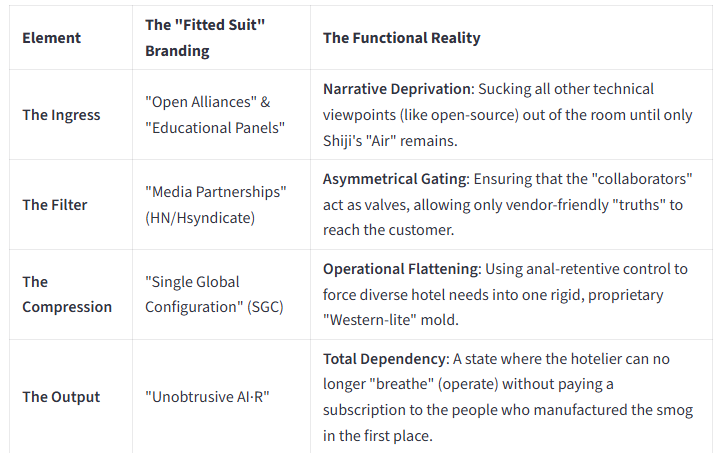
My theory is that the Oxygen Trap is an asymmetrical marketing funnel that doesn’t just sell a product, but attempts to own the very environment required to compete. The funnel operates through three distinct stages of psychological and operational capture:
- Narrative Deprivation: Collaborators and new industry alliances identify a “fragmented” landscape, creating a climate of fear. Recent data points to a “measurement gap” and reports that 98% of hotels are losing revenue every four days due to bad data.
- Expert Validation: Strategic “levers of truth” are then applied by industry veterans. In recent briefs, experts correctly warn of the “AI Agent Trap,” noting that isolated tools are trapped in vendor silos. This diagnostic truth is used to pivot the hotelier toward a “Super-Silo” solution.
- The Gilded Cage: The funnel ends at Shiji’s Single Global Configuration. By making AI “unobtrusive,” the vendor removes the hotelier’s ability to audit the system. When a vendor tells you that your staff “should not need to understand how models work,” they are effectively removing your right to own your operational intelligence.
The Alternative: Reclaiming the Technical Spine
Meanwhile, the “AI-First” future described by Boston Consulting Group (Argo story here) doesn’t require a single-vendor chokehold. True innovation lies in Open Orchestration—using standards such as the Model Context Protocol (MCP) that enable AI to communicate across any stack without a central jailer. However, other entities will attempt to rebrand “bolt on” AI to steal the thunder of what BCG says will be the future of the industry.
The industry stands at a crossroads. It can accept “Air” as a subscription-based utility, or it can demand the transparency that actual experts know is required for survival. As the independent investigation cuts through the corporate smog, the industry is finally beginning to smell what’s actually cooking in the swamp.
The genius of the Oxygen Trap is that it doesn’t look like a trap. It looks like relief. It looks like someone is finally solving your problems. It looks like the future is arriving to save you from complexity. But what it actually does is create a dependency structure so complete that by the time you realize you’re suffocating, you’ve already forgotten how to breathe on your own.
Blueprint for the Uncaged Hotel
To survive the next decade, hoteliers must stop buying “Air” and start owning their Spine. This requires shifting from vendor-centric dependency to orchestration-centric control. The MCP lever allows for orchestration without the chokehold described above. A MCP (Model Context Protocol) is an open-standard bridge that allows AI agents to securely connect to any data source—PMS, CRM, POS—without a central vendor acting as gatekeeper. Utilizing the Shiji Way: Your AI must route through Shiji’s “Air” layer. You pay their API tax. They control the filter. Conversely, the MCP Way is hosted on an MCP Server on your own infrastructure. Your PMS and AI both connect through your server via an open protocol. Shiji cannot tax or blind the connection. You can swap PMS vendors without breaking your AI layer—the agents aren’t trapped in vendor silos.
In the legacy tech marketing space, AIHA is positioning itself as a solution. However, a quieter coalition is building for interoperability. Some examples are: Open Hospitality Stack, Vendor Alternatives like Apaleo (API-first headless PMS), and Platform-Agnostic Orchestrators such as PolyAI and Hera. What is crucial in all of this is the Practice of Sovereignty, in which Hotels hire a Head of Intelligence rather than just a Director of IT. This role manages Model Context, not hardware. They ensure guest data flows into hotel-owned repositories, and AI agents remain interchangeable tools—not “Air” that can be shut off over a billing dispute.

[…] modern report is complete without invoking artificial intelligence as the solution to everything short of bad weather. As complexity grows, travel managers are turning to technology to keep their […]