A recent study by BCS Bus, a business transportation provider, analyzed business infrastructure and leisure conditions across 94 European cities and 30 countries to determine where business trips feel most like vacations. The report reveals Barcelona as the city with the highest score, at 79.5 on the Bleisure Index.
Barcelona topped the list for several reasons. For most business travelers many cities force a kind of binary experience: you’re either there for the conference center and the expense account, or you’re there for the cathedral and the beach. Barcelona lets you walk out of a meeting and directly into a different register of attention without crossing a threshold that feels like betrayal of purpose.
In addition, Barcelona’s infrastructure is competent but not sterile. The leisure is accessible but not desperate for your attention. You can get work done, then stop working, and both feel native to the place rather than imported. Conversely, cities like Paris score low because they demand something from you. It has aesthetic authority. You can’t just casually enjoy Paris between emails—it wants your full romantic commitment, or it punishes you with expensive inconvenience and clouds.
Barcelona’s advantage is its temperamental nature: it’s warm without being tropical, urban without being grinding, historical without being museum-ified. It has beaches you can actually use, not just photograph. The Ramblas is tourist-compressed, but you can walk two blocks and find normal life.
The “bleisure” framing is corporate-speak, but it points to something real: the psychological cost of switching between work mode and human mode. Most cities tax that switch heavily. Barcelona has a lower switching cost. It’s not the best city for deep work. It’s not the best city for losing yourself in beauty. But it might be the best city for doing both in the same afternoon without feeling like you’re failing at one to do the other.
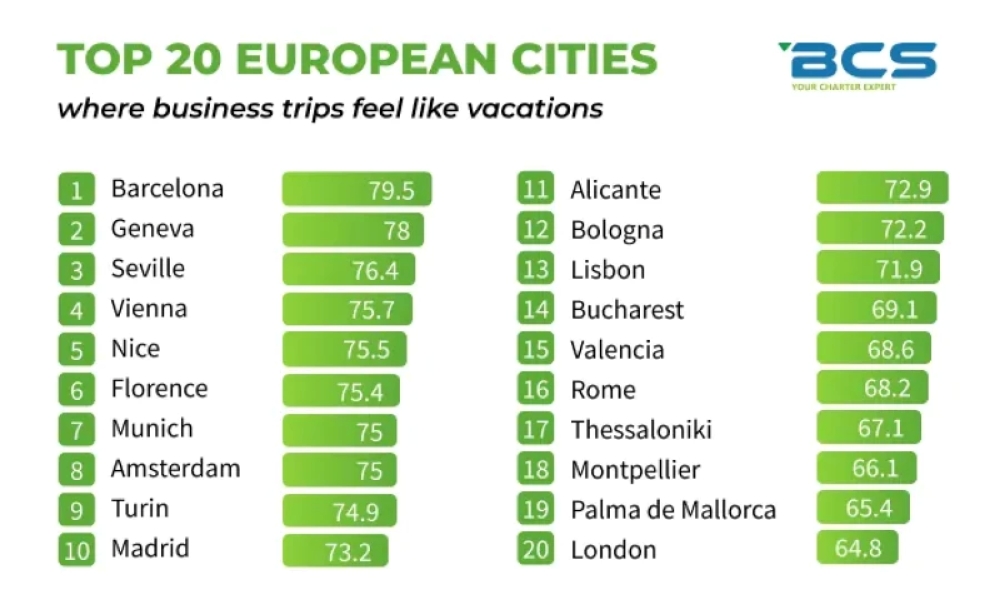
Here are some key findings from the study, followed by a list of the top 20 cities in the study:
- Barcelona is the #1 European city that combines robust business infrastructure with Mediterranean resort conditions, delivering what other cities can’t.
- 32.4 coworkings and 166.51 conference venues per 100 km² sit within walking distance of beachfront locations – executives transition from boardroom to beach without logistics headaches.
- 224 direct flights connect Barcelona to major business hubs, with most conferences located within a 15-minute transit of leisure districts.
- 142 bars and cafés per 100 km² and 75 attractions per 100 km² create seamless after-meeting entertainment without travel time.
- 2,591 annual sunshine hours (vs London’s 1,675 or Munich’s 1,792) guarantee reliable weather for relaxation after a conference.
- Over 2 million overnight stays in 2024, with Barcelona’s BLeisure Index of 79.5 outscoring Geneva (78) and Vienna (75.7).
- Searches for “what to visit in Barcelona” surged +110%, indicating business travelers are actively researching leisure activities, not just hotels and conference centers.
- Barcelona solves what other cities can’t: you can close a deal at 3 pm and be on the beach by 4 pm, without sacrificing conference quality or business connectivity.
Short methodology
The “BCS BUS” team ranked 94 European cities based on ranking European cities where business trips feel most like vacations by combining three key dimensions: Business-Friendliness, Leisure, and Tourism Appeal. Each city’s Business-Friendliness Index considered average weekday hotel prices, number of direct flights, coworking spaces, and conference venues (equally weighted). The Leisure Index factored in sunshine hours (50%), density of bars and cafés (30%), tourist attractions (10%), and safety (10%). The Tourism Appeal Index measured global search volume for “visit city” and total tourist overnight stays in 2024 (equally weighted).
All metrics were standardized per 100 sq. km using Eurostat’s city boundaries and normalized for comparability. The final score combined Business-Friendliness (40%), Leisure (50%), and Tourism Appeal (10%) into one composite ranking. Data were sourced from trusted platforms, including Eurostat, Numbeo, TripAdvisor, Wikidata, Amadeus, Ahrefs, FlightsFrom, Coworker, and Cvent, collected between September and October 2025.
Readers can find the full table with all indexes & metrics via this Google Sheet Link.
