The escalation of the Middle East conflict is beginning to affect international travel demand, with new data indicating a clear deterioration in security perception across Gulf destinations and early signs that travellers are redirecting their plans toward alternative regions.
According to analysis by Mabrian, part of the Almawave–Almaviva Group, traveller sentiment has weakened sharply in recent weeks, particularly in key outbound markets such as the United States and Western Europe. The findings are based on comparative travel intelligence covering behaviour and perception trends in the United Kingdom, Germany, France, Italy, and the United States, as well as destinations considered within the conflict’s wider sphere of influence.
The study also includes neighbouring countries such as Egypt, Türkiye, and Jordan, which, although not directly involved, are experiencing secondary effects on traveller confidence.
Security Perception Declines Across Gulf Destinations
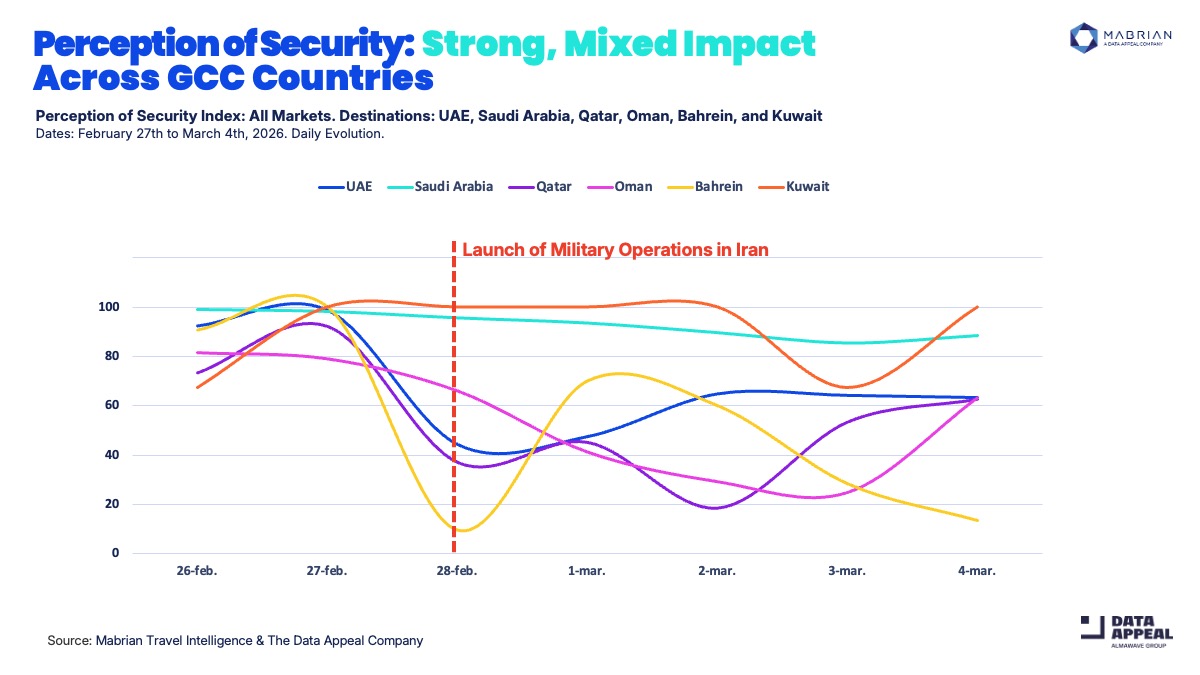
Mabrian’s Perception of Security Index shows a significant drop in traveller sentiment across Gulf Cooperation Council destinations following the escalation of military operations in late February.
The decline varies by country but is substantial in several cases:
- Bahrain fell by 81 points, reaching 9.6 out of 100
- Oman dropped by 56.7 points to 24.8
- Qatar declined by 54.9 points to 18.4
- The United Arab Emirates fell by 48.3 points to 51.9
- Saudi Arabia declined by 13.6 points to 85.3
Despite the decreases, the United Arab Emirates and Saudi Arabia appear to retain comparatively higher levels of perceived stability. At the same time, Bahrain and Oman show slower signs of recovery.
The data highlights how strongly security perception functions as a reputational factor in tourism, particularly for destinations that have invested heavily in positioning themselves as safe and stable.
Spillover Effect Visible in Neighbouring Countries
Countries near the conflict zone are also experiencing a decline in confidence, even without direct involvement.
Jordan’s security perception index fell by more than 30 points before gradually recovering.
Türkiye recorded a drop of around 25 points, with no clear rebound yet visible.
Egypt shows the smallest decline, but sentiment remains unstable.
These shifts reflect what analysts describe as a contagion effect, where geographical proximity alone is enough to influence travel decisions.
Over the past decade, many of these destinations have worked to build strong reputations for safety. The latest data suggests that such reputational gains can weaken quickly when geopolitical tensions rise.

US Travellers Show the Strongest Reaction
One of the most consistent patterns in the analysis is the high sensitivity of American travellers to security concerns.
Among US travellers, perception scores dropped sharply across multiple destinations:
- Kuwait declined by more than 87 points.
- United Arab Emirates by more than 79 points.
- Saudi Arabia by nearly 18 points.
- Egypt also recorded a significant fall.
Trend lines currently show limited signs of rapid recovery in this market segment, suggesting that long-haul demand may remain cautious in the short term.
According to Mabrian, this sensitivity can influence overall travel flows, as American travellers represent an important share of long-distance tourism.
Early Signs of Demand Diversion
The analysis identifies several emerging patterns in outbound travel demand from Europe and the United States.
One trend points to travellers choosing destinations closer to home. German travellers are showing increased interest in Greece and Morocco, while Italian travellers are shifting toward Croatia, Spain, and Central Europe. British travellers are also favouring nearby destinations such as Malta and Montenegro.
A second trend shows continued demand for Asian destinations, supported by direct flights to Japan, Thailand, Vietnam, Cambodia, and the Philippines.
A third pattern involves long-haul alternatives, with destinations such as South Africa, the Maldives, Peru, and Brazil attracting interest as substitutes.
Egypt remains popular among European travellers, but analysts note that this demand is highly exposed to developments in the regional conflict and could change quickly if travel advisories or connectivity restrictions increase.
Confidence Remains the Most Fragile Factor in Tourism
According to Mabrian, the current situation illustrates how strongly tourism depends on perception rather than physical risk alone.
Destinations that have spent years building an image of stability can see that perception change within weeks, especially when geopolitical tensions affect air travel, media coverage, and government advisories.
Restoring confidence, analysts say, will become a priority once the conflict subsides, as travel demand already shows signs of redistribution toward regions considered more predictable.
In periods of uncertainty, monitoring traveller sentiment, connectivity, and booking trends becomes essential for destination planning, particularly in markets where demand can shift quickly.
