The Mapuche named it Lugar de Oro — the Golden Place — not for any metal buried beneath the soil, but for the way the horizon catches fire at dusk, rose-gold light spilling across the Cachapoal Valley as molten amber poured from the Andes themselves. One hundred miles south of Santiago, where the Pacific fog drifts inland, and Andean winds carve the slopes, Alexander (below left) and Carrie Vik arrived in 2004 with no blueprint, no spreadsheet, only a single, almost reckless question: “Where in the world can soil, sun, and silence conspire to make wine that belongs in the pantheon?”
Their search lasted two years. When it ended, they owned 11,000 acres of untouched wilderness — no vines, no roads, no history of cultivation. They did not rush to plant. They listened.

Today, that land is VIK, a 4,450-hectare sanctuary where Cabernet Sauvignon, Carménère, Syrah, and Merlot grow in quiet conversation with volcanic rock, ancient clay, and the slow tilt of the hills. Chief winemaker Cristián Vallejo directs harvests that begin only after dark, when cool air locks in the grapes’ essence. There are no additives, no filtration, no cultured yeasts. Native yeasts alone do the work. The wine is stripped to its bones — terroir speaking in its own voice, without translation or apology.
But VIK’s deepest secret lies higher, at 3,000 feet, in a ring of century-old oaks growing where no forest should. In 2023, Vallejo noticed the anomaly: a perfect circle, as if the trees had arranged themselves around an invisible center. A geologist traced a fault line intersecting a subterranean water vein — a natural electromagnetic pulse radiating from the exact point. Then came the machi, a Mapuche healer. Without knowing the geology, she walked the ridge, stopped, and said quietly:“This is where the spirit lives.”
Seven amphorae were shaped from VIK’s own clay and placed within the circle to catch the solstice light. Into them went a blend of Cabernet Franc, Cabernet Sauvignon, and Carménère. For five months, the wine rested untouched by human hands, cradled by oak roots, moonlight, and the low hum of the earth. On December 21, the Southern Hemisphere’s summer solstice, it was drawn and bottled: Stonevik.
No intervention. No barrels. Only the wine and the wild intelligence of the place itself.
James Suckling, one of the world’s most influential wine critics, awarded 98 points to both vintages. Not for winemaking technique. For truth. VIC has been named the finest winery in the world, and for just cause.
This is the closing of VIK’s “circular” vision, first glimpsed in 2018 when they began crafting barrels from French oak staves toasted over 300-year-old Chilean oak fallen within the reserve. Vallejo called it barriére—terroir extended into wood. With Stonevik, the circle completes: the wine returns to the forest that gave it life.
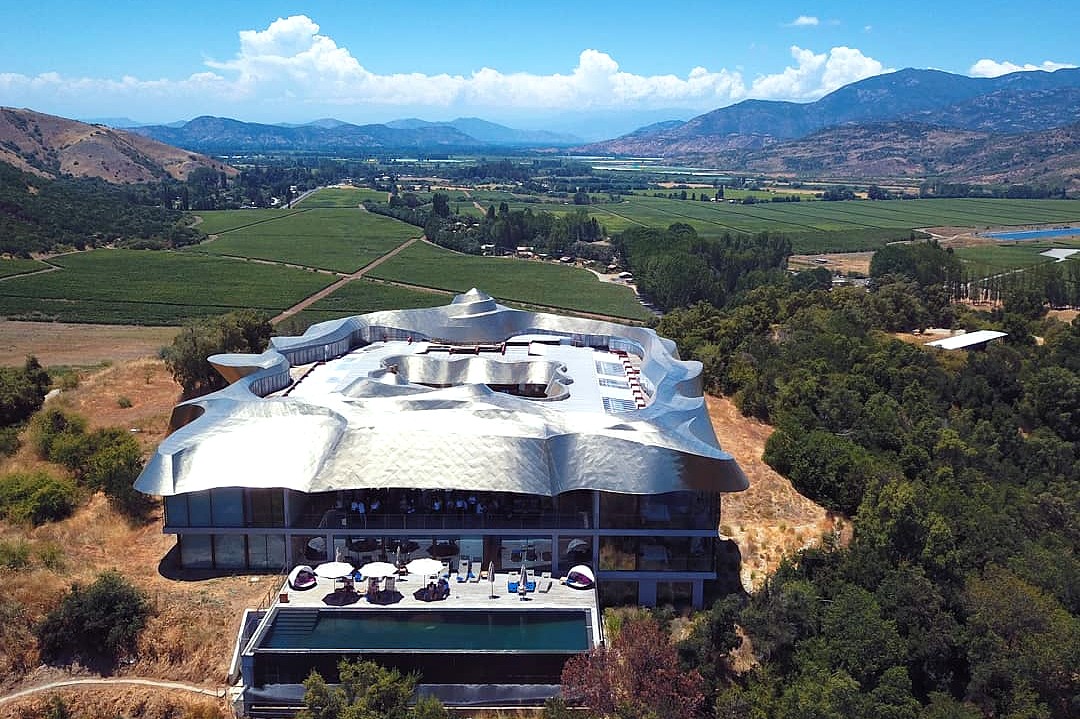
At the estate, Smiljan Radic’s winery floats above the valley like a wing — translucent by day, glowing by night. Water trickles over river stones to cool the cellar naturally. At Milla Milla, duck magret meets blueberry sauce beneath a ceiling of light; at La Huerta, lunch rises from 250 varieties grown in the estate’s gardens. The hotel’s bronzed titanium roof undulates in the sun, sheltering 22 artist-designed suites: one lined with 50,000 euro cents, another crowned by Dalí’s Lips sofa. Puro Vik’s glass bungalows hover between holograms and 18th-century France, each bathroom carved from marble veined like the earth itself.
Yet none of this feels indulgent. It feels devotional.
Every decision — midnight harvests, amphorae in sacred groves, barrels toasted over ancestral wood — serves one purpose: to let the land speak without interruption. As Vallejo says, “I think of our wines as a book. Every glass is a chapter. Every sip, a page.”
Drink Stonevik, and you do not taste fruit or oak. You taste a fault line singing. You taste a machi’s blessing. You taste the silence between stars on the solstice night when the earth turned toward the light.
Alexander Vik says they are “ahead of schedule.” But this was never about schedules. It was about trust — in soil that remembers, in science that listens, in spirits older than borders.
One visitor described the experience of having left at dawn, Stonevik in his bag, and the taste of wild thyme and dark fruit lingering on the tongue. But what partakers often carry deeper is an unexpected certainty.
This place knows you before you arrive.
And perhaps, in the quiet alchemy of fault lines, fallen oaks, and surrendered hands, it always will.
About the Area
Nestled in the heart of Chile’s Cachapoal Valley, the Millahue Valley is a hidden amphitheater cradled between the snow-dusted Andes and the cool breath of the Pacific Ocean. Its name—derived from Mapudungun, the language of the Mapuche people—means “place of gold,” a tribute to the way afternoon light gilds its rolling hills, wild grasses, and ancient oak groves. This is a land shaped by fire and fog: volcanic soils forged in tectonic upheaval, cooled nightly by maritime winds that sweep inland through mountain gaps. Twelve microclimates ripple across its folds, each slope whispering a different truth to the vines. There are no towns here, no highways—only silence, birdsong, and the slow rhythm of seasons. To enter Millahue is not to visit a wine region, but to step into a covenant between earth and sky, where time moves not by clock, but by root, rain, and solstice.
Getting There
From Santiago → VIK
SCL airport → private transfer (VIK arranges this as part of the booking).
Distance: ~100 km south (1.5–2 hours by car).
VIK’s drivers meet you at arrivals with a name sign; the drive is scenic (highway, then winding valley roads).
