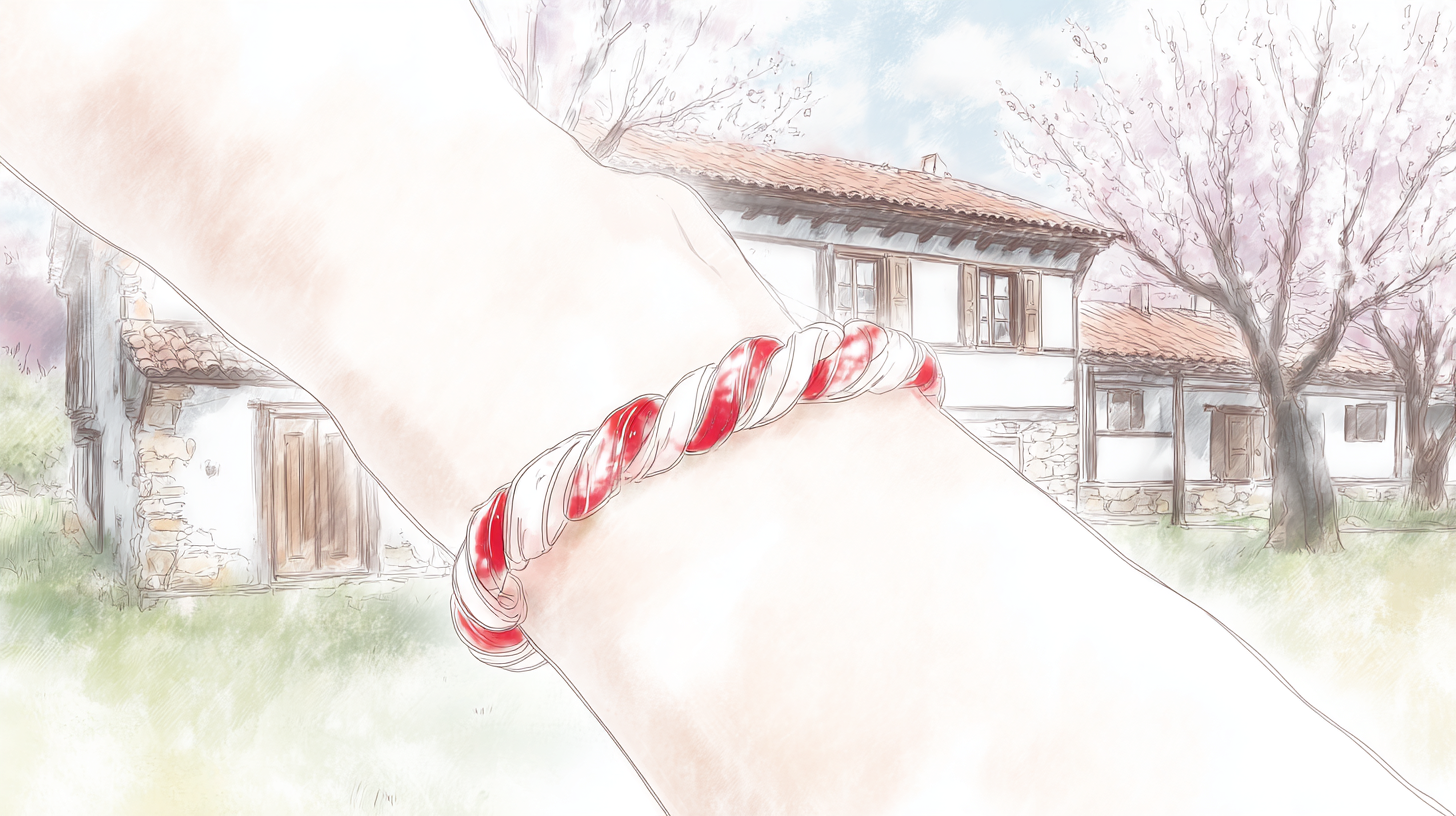
- The Martis is a red-and-white twisted bracelet worn throughout March in Greece.
- The tradition likely dates back to Ancient Greece and the Eleusinian Mysteries.
- March was historically associated with renewal and marked the beginning of the year in the Roman calendar.
- The Byzantine-era Chelidonismata (Swallow Songs) celebrated the arrival of spring.
- White thread symbolizes purity; red symbolizes life, health, and vitality.
- The bracelet was believed to protect children from the “treacherous” March sun.
- Today, it remains a beloved cultural symbol of spring and continuity.
If you find yourself in Greece in early March, look closely at people’s wrists. You will notice something small but unmistakable: a thin red and white twisted bracelet. Children wear it. Adults wear it. Even the most polished professionals quietly keep one tied around their wrist.
This is the Martis — named after March — and it carries centuries of memory in two simple threads.
Ancient Echoes
The custom is believed to trace back to Ancient Greece, possibly to the Eleusinian Mysteries. Initiates in those sacred rites tied a thread known as the kroke around their right hand and left foot—a small thread, yes — but charged with symbolic meaning.
March itself carries a layered history. Its name comes from Mars, the Roman god of war — known to the Greeks as Ares. In the Roman calendar, March was once the first month of the year. In the ancient Greek calendar, it roughly corresponded to the month of Elaphebolion — a time associated with festivals, renewal, and the first true light of spring.
Swallows, Songs, and Spring
By the Byzantine period, March 1 was celebrated with lively festivities. One of the most charming traditions tied to the season is the Chelidonismata, or Swallow Songs.
On March 1, children would carry a wooden swallow from house to house, singing to announce the arrival of spring. In return, they received small gifts — often eggs. It was a ritual of awakening, marking the shift from winter’s stillness to spring’s movement.
Beauty, Sun, and Protection
The Martis bracelet is traditionally worn from March 1 until the end of the month.
Its symbolism is simple:
- White represents purity.
- Red represents life, health, warmth, and vitality.
But there is also a practical layer hidden beneath the poetry.
In Greek folklore, the March sun is considered deceptive — still gentle enough to underestimate, yet strong enough to burn. The bracelet was believed to protect children’s skin from tanning or “burning” under the early spring sun.
Decades ago, pale skin was a marker of refinement. Those who worked in the fields grew dark under the sun; those who did not were seen as privileged. The Martis served as a protective charm—and a subtle social reminder.
Today, few wear it for status or sun protection. Most wear it because it feels like a spring tied around the wrist. A quiet ritual. A red and white whisper that winter is ending.
A Shared Thread Across the Balkans
On March 1, Romania celebrates Mărțișor, perhaps the country’s most recognizable symbol of spring. Some insist it is uniquely Romanian, woven exclusively into the national fabric. Others acknowledge a broader truth: that this small red-and-white thread travels easily across borders, embraced by neighboring cultures that recognize themselves in it.
Because the thread is older than modern frontiers.
Mărțișor refers not only to the day, but to the braided red and white cord from which small charms are suspended. Its symbolism echoes throughout the region: white and red intertwined — night and day, winter and summer, frailty and strength, illness and health, endings and beginnings.
Under different names, the same ritual appears across the Balkans:
- In Bulgaria, it is Martenitsa.
- In North Macedonia, Martinka.
- In Greece, Martis.
- In Romania, Mărțișor.
In Albania, the name shifts entirely — Verore, rooted in Dita e Verës, the Day of Summer, celebrated on March 14 according to the Gregorian calendar (March 1 in the old Julian reckoning).
Different languages. Same gesture.
A thread tied at the wrist to greet the sun. A quiet declaration that winter has lost.
The red-and-white bracelet may look delicate. But it carries centuries — and a shared Balkan memory — lightly around the wrist.
