According to forester Giannis Fotakis, Crete is slowly but steadily turning into a place where investment goes to die quietly, surrounded by maps. Especially Chania.
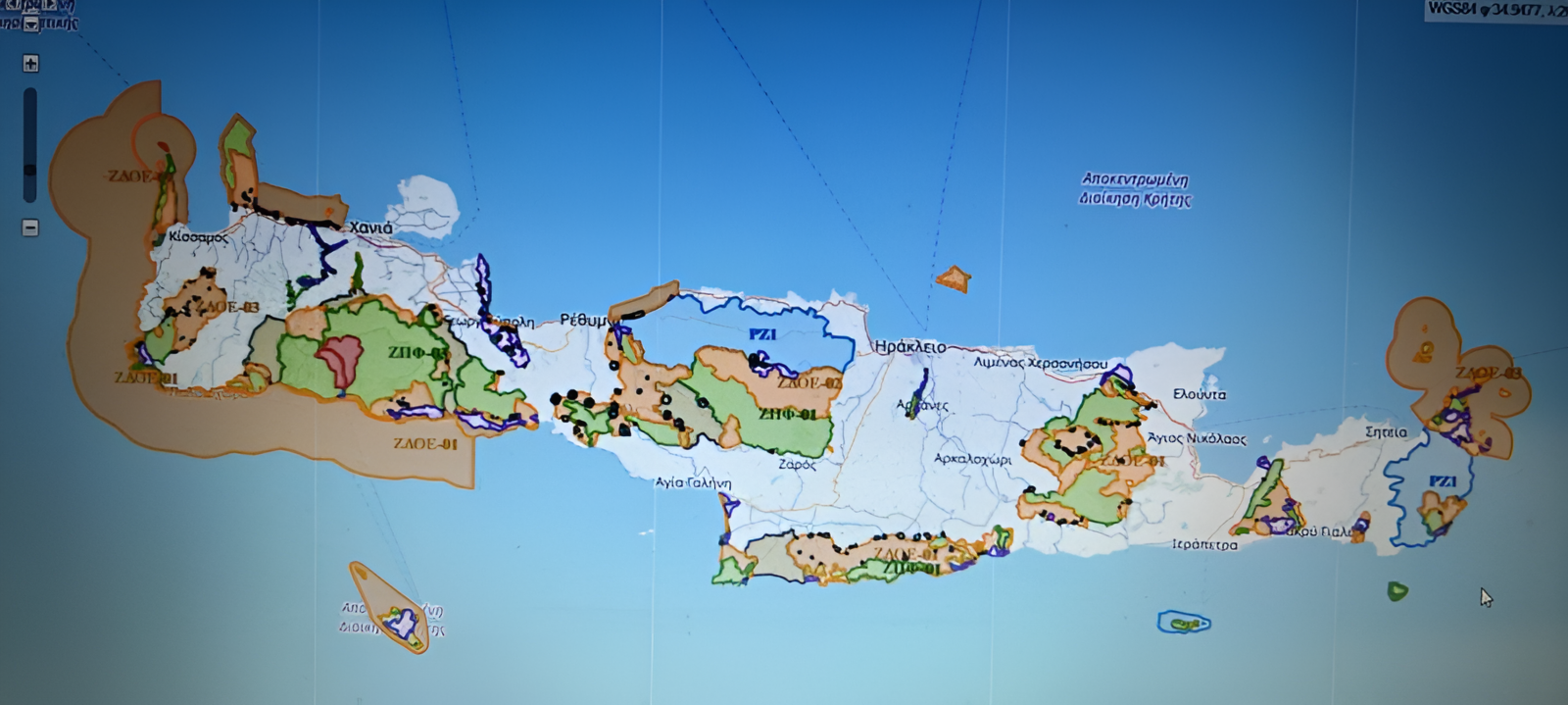
If the current environmental designations continue to accumulate at this rate, Chania will soon become officially non-investable. Not because there is nothing to build, but because no one will be able to understand where, how, why, and under which lunar phase anything is allowed.
Crete, it seems, is sliding down several levels of “investment freedom,” a metric that nobody voted for but everyone will eventually feel.
And the best part?
Most locals have no idea this is happening.
The Map That Ate Crete
The attached map, Fotakis says, “speaks for itself.”
Which is unfortunate, because no normal human can actually read it.
This is the result of environmental decisions taken over several decades — 1987, 1999, 2003, 2011, 2018, and finally 2020 — layered one on top of the other until Crete resembles a bureaucratic mille-feuille.
And the map is still incomplete.
It does not include:
- Certain protected zones under Law 3739/11
- Three additional protected areas in Chania under Law 3208/03
Add those later.
Then add:
- New out-of-plan building restrictions
- Upcoming spatial planning for Tourism
- Upcoming spatial planning for Renewable Energy (RES)
Still following? Good. Now breathe.
Now Add Mountains, Beaches, and Confusion
Next, throw in:
- “Untouched mountains”:
- 300,000 stremmas in Chania
- 120,000 stremmas in Lasithi
(Conveniently not addressing overgrazing or illegal hunting.)
Then sprinkle in:
- “Untouched beaches,” introduced in April 2024
- At least 20 beaches in Crete
- Curiously absent from current ministerial decisions
At this point, the map stops being a planning tool and becomes an escape room.
With all this complexity, a new job category emerges naturally: The Environmental Interpreter.
Someone who can look at the map, sigh deeply, and say: “Yes, technically you cannot, but maybe if…”
Universities finally succeed in “connecting education with production,” producing experts who translate colored polygons into something vaguely understandable.
Who Wins?
Not the middle class.
With this level of bureaucracy and environmental overreach, the middle class appears in only one role:
Seller of ancestral land.
The sacred goal — protecting the environment — somehow ends up packaged neatly inside fast-track investment schemes and real estate transactions, rather than where it belongs: education.
Because if environmental protection is meant to last, it should start in schools.
But that, as Fotakis politely notes, is “another discussion.”
Does Anyone Actually Know What Is Happening?
That is the real question. Do fishermen know what the mysterious brown zone covering the western and southern coasts means for them?
Has anyone explained it clearly? Repeatedly? Out loud?
Local government, the institution closest to citizens, hides behind:
- Online consultations
- Institutional boundaries
- And a general “it’s on the website” attitude
Other bodies remain impressively silent.
Chania, already burdened with additional military zones, risks becoming the dumping ground of the middle class. And here the issue is no longer just administrative failure — it becomes political. Representation is supposed to work from the bottom up, and right now, the bottom is staring at a map it cannot read.
