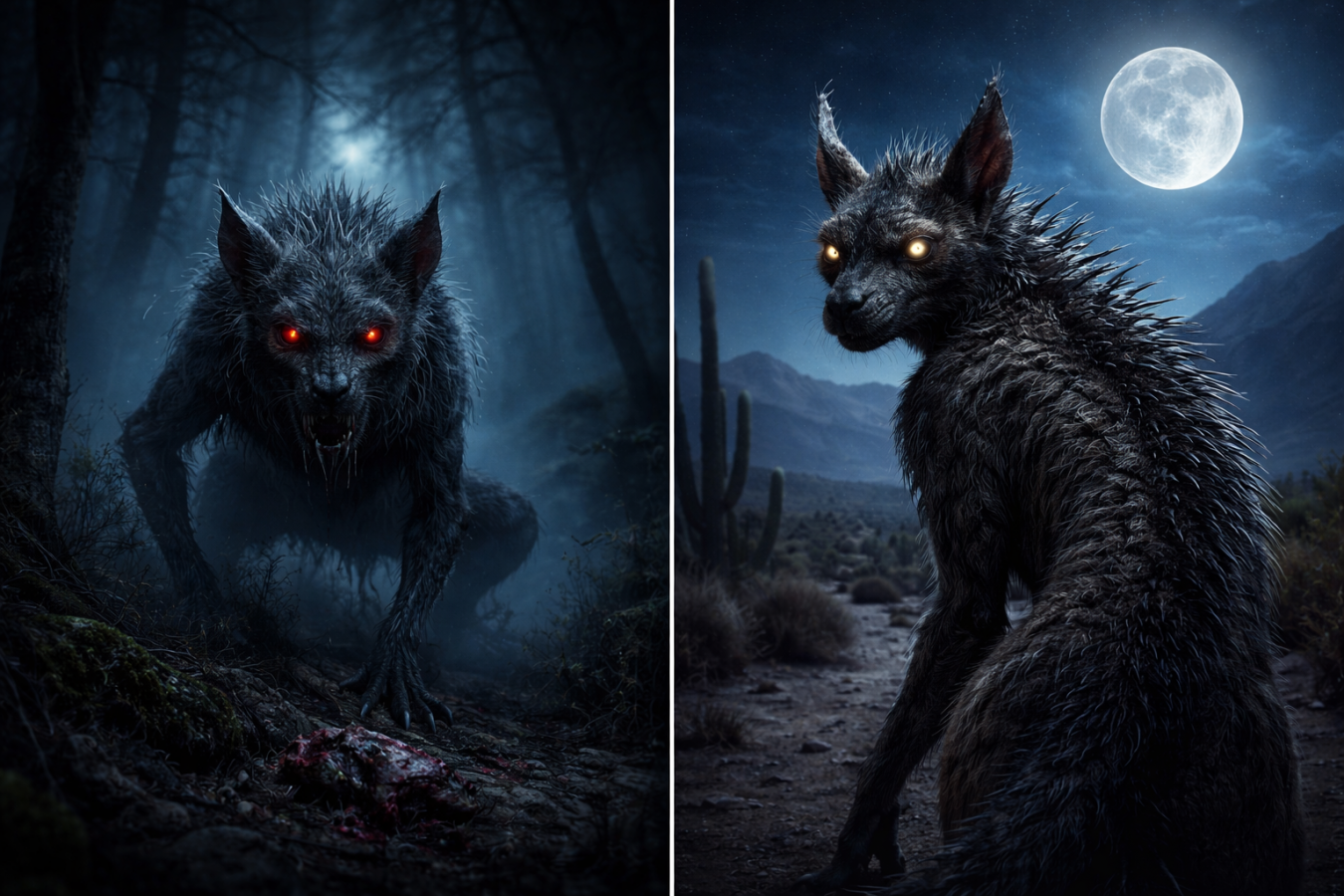
COQUIMBO REGION, Chile — Local farmer Hernán Vásquez reported an unusual encounter late last month: a tall, red-eyed creature that he believes may be the legendary chupacabra, though he emphasized the animal was “surprisingly tidy and respectful” in its alleged goat-visiting activities.
This is not the first time the region has played host to such speculation. In fact, when viewed alongside historical data from 2015, a pattern emerges: one of cryptid consistency, cephalic anomalies, and surprisingly good manners.
The 2026 Claim: A Gentleman Monster
According to Vásquez, 58, the incident occurred at approximately 3 a.m. on February 27, when he heard “screaming goats—not like usual.” Investigating with a flashlight, he claims to have seen a creature with “eyes like red marbles” that “hissed respectfully” before vanishing into the scrub.
Three goats were allegedly found the next morning “drained, but tidy,” with no signs of struggle.
“It’s respectful, I’ll give it that,” Vásquez told our correspondent. “No mess. No fuss. Just efficient hemolymph extraction. Ten out of ten, would be vaguely terrified again.”
The 2015 Precedent: The Monte Patria Incident
The Coquimbo region has form. In January 2015, goat farmer Javier Prohens and his farmhand, 54-year-old Bricio Saldivar, discovered two mysterious carcasses on the outskirts of Monte Patria in Limarí Province.
According to reports at the time, Saldivar alerted Prohens and his lunch guests to the discovery, having found the “strange bodies” near an old winery. The partially mummified remains were located in a cellar among hay bales.
“At first we thought they might be bats,” Prohens was quoted as saying, “but when we looked closer, we realized they had to be something else as the heads were too big for bats. And then someone said they looked like Chupacabras.”
The specimens were never definitively identified, though local authorities suggested they may have been dogs with mange—a diagnosis that has become the cryptozoologist’s equivalent of “it’s just foxes.”
When asked whether the 2026 creature might be related to the 2015 Monte Patria specimens, our correspondent attempted to contact Prohens and Saldivar for follow-up comment. Unfortunately, both were unavailable, though a neighbor reported seeing them “sitting at the old winery, drinking pisco, and muttering something about tidy carcasses and excellent empanadas.”
The Academic Response (Probably)
The incident has sparked renewed interest in chupacabra research, including a thesis titled “The Blood Sucking Hidden Monster Chupacabra” by Muhammad Muzammal and Sana Fatima. The abstract notes that the creature “has experienced a rebirth in recent years” and has been reported in “America, Chile, Brazil, India and recently in Islamic Republic of Pakistan.”
The authors conclude: “Whatever it is, but it is dangerous.”
When asked for comment on this definitive assessment, Dr. Elena Rojas (probably), wildlife biologist at Universidad de Chile, reportedly nodded sagely and said, “Yes. Whatever it is. But it is dangerous. Also, please stop emailing me about this.”
Juan Valdez, our biology major correspondent (currently interning at Café Valdez, not to be confused with the Juan Valdez, though he does make an excellent cortado), added: “I read the thesis. It’s very thorough. Also, I may have skimmed it. Also, the coffee at Café Valdez pairs excellently with cryptid literature.”
The Mystic Highlight: A Creature of The Between
From a metaphysical perspective, the chupacabra occupies a unique niche in the architecture of the field. It is neither fully real nor fully imagined; it exists in the liminal space where fear meets folklore.
The 2015 report of “heads too big for bats” suggests a distortion of perception—a gradient where the ordinary (bat) slides into the extraordinary (monster). The 2026 report of a “respectful” creature suggests an evolution in the phenomenon: the field is articulating itself with more manners.
Perhaps the chupacabra is not a creature at all, but a manifestation of the land’s memory. Or perhaps it’s just Jethro’s cousin, lost and hungry. The field does not require resolution; it requires clear seeing.
The Statistics (With Googly Eyes)
Using the proprietary Valdez-Rojas Cryptid Probability Matrix (VRCM-7)—which appears to be an abacus with googly eyes—researchers calculated the following likelihoods:
| Possibility | Likelihood | Notes |
|---|---|---|
| Actual chupacabra (consistent visitor) | 15.7% | It’s polite. It’s tidy. It’s got a type. |
| Dogs with mange (2015), fox with identity crisis (2026) | 42.3% | Variety is the spice of cryptozoology. |
| Jethro’s cousin (visiting regularly) | 11.2% | He really likes Chile. We should talk to him. |
| Mass hallucination (excellent pisco) | 8.9% | The 2015 vintage was particularly strong. |
| Big-headed bats | 6.4% | Ego problems confirmed. |
| Gamma-powered goat (time traveler) | 15.5% | Explains the consistency. Also the tidiness. |
Note: Percentages still exceed 100% because mathematics is a social construct, and chupacabras are not.
The Gamma Question
While no gamma radiation was detected at the site—equipment was unavailable, and researchers admitted they “don’t know how to test for that”—the possibility that the creature is gamma-powered cannot be entirely ruled out.
When asked for comment, a source close to the situation (who may or may not be named Jethro) reportedly muttered something about “Gamma being a brand of chewing tobacco” before walking away.
Recommendations for Travelers
The Chilean National Agriculture Service (SAG) has not confirmed the sighting, though a spokesperson was quoted as saying, “Please stop sending us blurry photos.”
Local tourism officials have adopted a strategy of “neither confirm nor deny,” with one guide reportedly launching “Chupacabra Watch” night tours that include “flashlights, hot pisco, and a 95% chance you’ll see a very enthusiastic fox.”
If you encounter the creature:
- Stay calm.
- Say “please” and “thank you.”
- Offer it an empanada.
- Call us.
- Also, maybe call the actual authorities. Just in case.
Where to Stay: Chupacabra Country Lodging Guide
Near Monte Patria (2015 Incident Site)
1. Hotel Rural El Molino – Monte Patria
- Why stay here: Literally in the heart of chupacabra territory
- Amenities: Rustic charm, on-site restaurant, respectful silence after 3 AM
- Chupacabra Perk: Staff reportedly “won’t judge if you scream at 3 AM”
- Real talk: Simple, clean, locally-run. Good base for investigating old wineries.
2. Hacienda Santa Cristina – Ovalle (20 min away)
- Why stay here: An old manor house built in 1938, which has belonged to the Hernández Gálvez family for more than 30 years. The manor has thick walls too. (good for blocking out goat screaming)
- Amenities: Pool, gardens, traditional Chilean breakfast
- Chupacabra Perk: “We’ve never had a sighting, but we keep the porch light on just in case”
- Real talk: Comfortable mid-range option with character.
Near Coquimbo Region (2026 Incident Zone)
3. Hotel Elqui Domos – Valle de Elqui
- Why stay here: Glass-ceilinged domes for stargazing AND cryptid-watching
- Amenities: Observatory, pisco tastings, astronomical tours
- Chupacabra Perk: “If you see red eyes in the night, it’s either a chupacabra or Mars. We’ll help you figure out which.”
- Real talk: Actually, a real, beautiful hotel. Perfect for astronomy + mystery lovers.
4. Tierra Atacama Lodge – San Pedro de Atacama (further north, but worth it)
- Why stay here: Luxury base for desert exploration
- Amenities: All-inclusive, expert guides, spa, stunning architecture
- Chupacabra Perk: “We specialize in the unexplained. Chupacabras, geysers, salt flats—we’ve seen it all.”
- Real talk: High-end, but if you’re going to hunt cryptids, do it in style.
For the Brave (Rural Stays)
5. Elqui Valley Avocado Farm – Countryside near Vicuña
- Why stay here: Working farm, authentic rural experience
- Amenities: Pool, friendly dogs, fantastic views, wonderful avocado dishes
- Chupacabra Perk: “Our goats have never been drained, but they’re very dramatic. You’ll hear screaming either way.”
- Real talk: Rustic, real, and you’ll sleep knowing you’re in the field.
6. Observatory Hotels (Multiple locations)
- Why stay here: Clear skies = good for stars AND cryptids
- Amenities: Telescopes, expert astronomers, night tours
- Chupacabra Perk: “If we can spot a galaxy 10 million light-years away, we can definitely spot a polite monster in the hayloft.”
- Real talk: The Elqui Valley is world-famous for astronomy. This is actually a great reason to visit.
5 Things to Do in Chupacabra Country (Besides Looking for Polite Monsters)
1. Stargaze in the Valle de Elqui
Why: One of the world’s clearest skies—International Dark Sky Reserve status.
Do: Book a night tour at Cruz del Sur Observatory or Mamalluca.
Chupacabra Bonus: “If you see red eyes moving against the stars, it’s either a satellite, a chupacabra, or you need more sleep. We recommend all three.”
2. Tour a Pisco Distillery
Why: This is the birthplace of Chile’s national spirit.
Do: Visit Capel or Pisco Control for tastings and history.
Chupacabra Bonus: “Pisco doesn’t solve cryptid mysteries, but it makes not solving them significantly more enjoyable.”
3. Explore Fray Jorge National Park
Why: A rare “fog forest” in the middle of the semi-arid north—lush greenery sustained by coastal mist.
Do: Hike the trails, spot endemic birds, breathe air that smells like mystery.
Chupacabra Bonus: “Perfect habitat for shy, tidy creatures. Also just beautiful. Win-win.”
4. Visit Vicuña & the Gabriela Mistral Museum
Why: Birthplace of Chile’s Nobel Prize-winning poet; rich Diaguita indigenous heritage.
Do: Wander the whitewashed streets, visit the museum, sip local wine in the plaza.
Chupacabra Bonus: “Mistral wrote about the soul of this land. Maybe she knew something about polite monsters. We’ll never know. But the empanadas are excellent.”
5. Wander the Ruins of Tulor de Coquimbo
Why: Ancient Diaguita archaeological site—stone foundations, ceremonial spaces, history underfoot.
Do: Walk respectfully, imagine the lives lived here centuries ago.
Chupacabra Bonus: “If the chupacabra is real, it’s probably been here longer than we have. Show some respect. Bring an empanada.”
Pro Tip for Travelers:
Combine stargazing + pisco + a rural stay = the perfect “Chupacabra Watch” evening. Just remember: if you hear goat screaming at 3 AM, check for foxes first. Then monsters. Then your own imagination.
⚠️ EDITOR’S NOTE: THIS IS SATIRE (well, perhaps)
This article is entirely fictional (mostly) and written for entertainment purposes. No chupacabras were confirmed, denied, or interviewed during its preparation. Dr. Elena Rojas may or may not exist. Juan Valdez is definitely not the Juan Valdez (probably). Jethro’s cousin remains at large. The goats are real, and they are judging you.
However, the 2015 Monte Patria incident is real. Javier Prohens and Bricio Saldivar are real people. The carcasses were real. The academic thesis by Muzammal and Fatima is real. The quote “Whatever it is, but it is dangerous” is a direct citation.
This story appears in our “The Between” section, where we explore the liminal space between fact, fiction, and things that make us laugh for 20 minutes straight. Please enjoy responsibly, with appropriate skepticism, and preferably with a good pisco sour nearby.
