The Cretan knife is not merely a tool. It is a symbol. A blade that has cut bread, carved wood, defended dignity, sealed friendships, and carried poetry along its spine.
Over the centuries, local artisans refined what began as a simple knife-yatagan into the iconic Cretan knife — slender, curved, engraved, and unmistakably tied to the island’s identity. On its blade, you will often find a mantinada, a short Cretan verse, etched by hand—steel and poetry, inseparable.
This March, in Chania, that tradition steps out of memory and back into human hands.
Every Monday throughout the month, workshops will take place at the Russian Barracks, offering participants the opportunity to step inside the world of the traditional knife maker. Guiding the experience is master craftsman Stavros Paterakis, a dedicated artisan of the traditional Cretan knife.
Participants will:
- Learn what defines an authentic Cretan knife
- Explore its historical evolution
- Discover the symbolic role it has played in Cretan life
- Carve their own mantinada, verb, or personal phrase using traditional engraving techniques
This is not a demonstration. It is hands-on heritage.
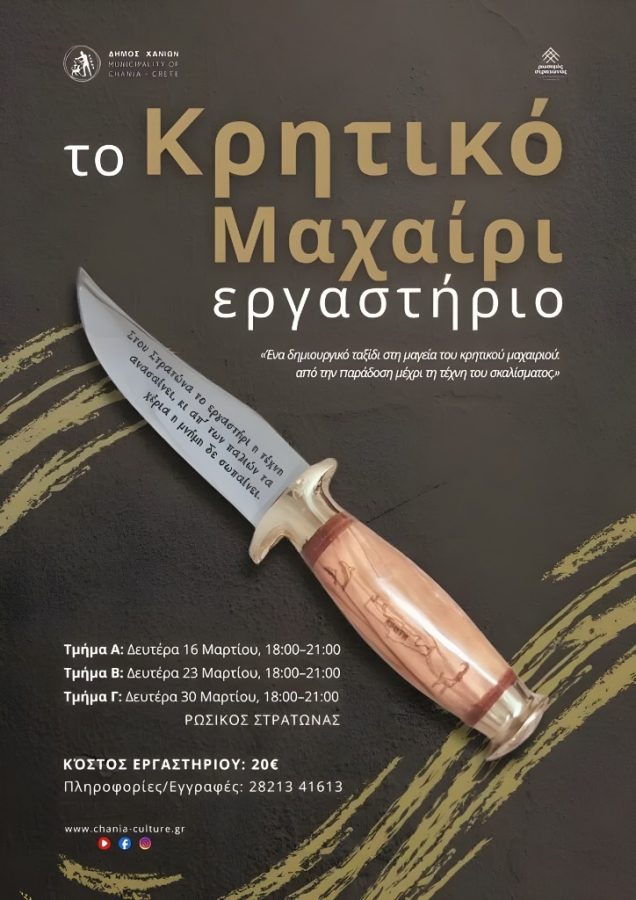
Workshop Dates
- March 16, 2026 | 18:00–21:00
- March 23, 2026 | 18:00–21:00
- March 30, 2026 | 18:00–21:00
Each workshop stands alone. You may attend one or all three.
Participation requires advance registration with the Municipality of Chania’s Cultural Department.
- Registration fee: €20
- Registration hours: Weekdays 08:00–15:00
- Location: Megalo Arsenali, Venetian Harbor, mezzanine offices
- Phone: +30 28213 41613
The workshops form part of the Municipality of Chania’s broader initiative to highlight the region’s intangible cultural heritage — including a series of videos dedicated to traditional professions that are slowly disappearing.
The Cretan knife is not disappearing while there are hands still willing to forge it — and others willing to learn.
