Summary (for busy humans who scroll like they are fleeing responsibility)
- Heraklion has two food worlds: the city center (priced for convenience + tourists) and the neighborhoods (priced for locals).
- The simplest way to eat well on a budget is to leave the center without overthinking it.
- Take any bus from the center in any direction, count five stops, get off, and wander.
- In the neighborhoods, you will often find the same dishes as in the center—only cheaper, bigger, and more honest.
- Fish is the exception: it is pricey everywhere, but still cheaper in neighborhood tavernas than in the center.
- If you eat near Koules/harbor, you are paying for location, not necessarily better food.
- Look for places where locals eat: workers, older couples, families, no hostess, no “tourist menu.”
- Best budget choices in Crete are usually ladera, legumes, oven dishes, omelets, and house wine.
If you want to eat well in Heraklion on a budget, do not ask Google. Do not read ten “best restaurants” lists written by someone who spent 48 hours here and thinks dakos is a personality trait.
Do something far more scientific.
Take a bus. Any bus. From the center, in any direction. Count five stops. Get off.
And then—this is the key part—get lost.
Not “lost” like a tragic tourist who has accidentally entered a parallel dimension and now needs assistance from the Greek army.
Lost like a local. Lost as you belong there. Lost, like the only thing you are searching for is lunch.
Because Heraklion is not one city, it is two.
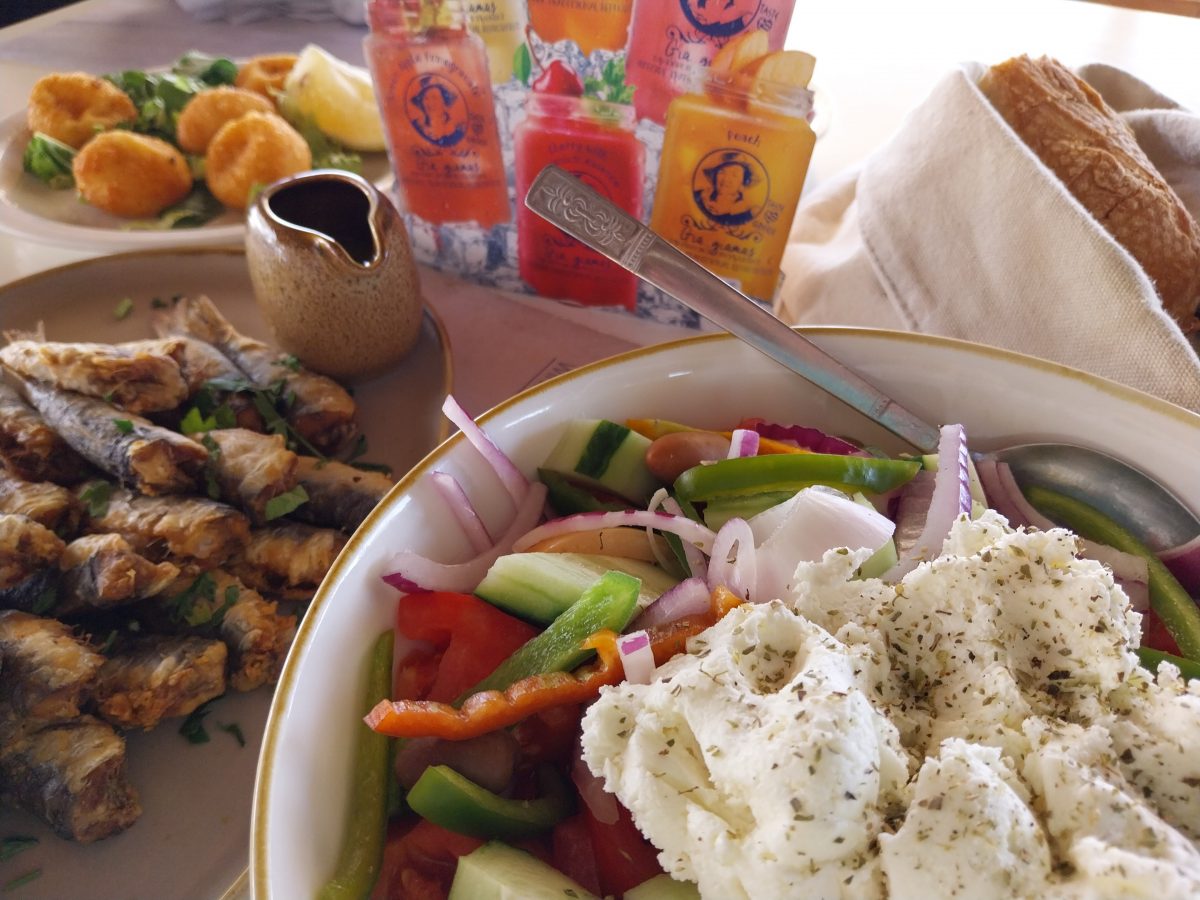
Heraklion Has Two Food Cities
The city center is not evil. The center is simply expensive because it has to be. It serves:
- visitors who want dinner five meters from their hotel,
- locals who want convenience,
- and restaurants that pay center rent to exist.
So the prices rise quietly, like summer heat creeping under your shirt. You do not always notice it until the bill arrives and you realize you have paid extra for the privilege of sitting within Instagram range of the harbor.
But then you leave the center.
And something beautiful happens.
Heraklion’s neighborhoods start feeding you the way Crete feeds its own people: without theatre.
Same olive oil. Same tomatoes. Same grills. Same cooks who could absolutely work in a fancier place if they wanted to. The difference is not the food.
The difference is rent, tourists, and the fact that the restaurant does not have to print its menu in six languages to survive.
The Five Stops Rule
This trick works exceptionally well in Heraklion because Heraklion is big.
Chania and Rethymno are smaller. You can walk ten minutes and “accidentally” hit local territory. They are not as bus-focused in daily survival terms because their center-to-neighborhood transition happens faster and more naturally.
Heraklion is different. Heraklion is spread out and practical. You are either in the center machine or you are out.
So you exit the machine.
Any bus. Any direction. Five stops.
At five stops you are:
- far enough from tourist pricing,
- far enough from “center convenience tax,”
- but still inside the living organism of Heraklion.
And then you wander until you find a neighborhood place that looks like it has existed long enough to survive three governments and a bad winter.
If you see workers eating, older men arguing gently, families with children, a waitperson who looks tired in a normal way… Congratulations. That is your taverna.
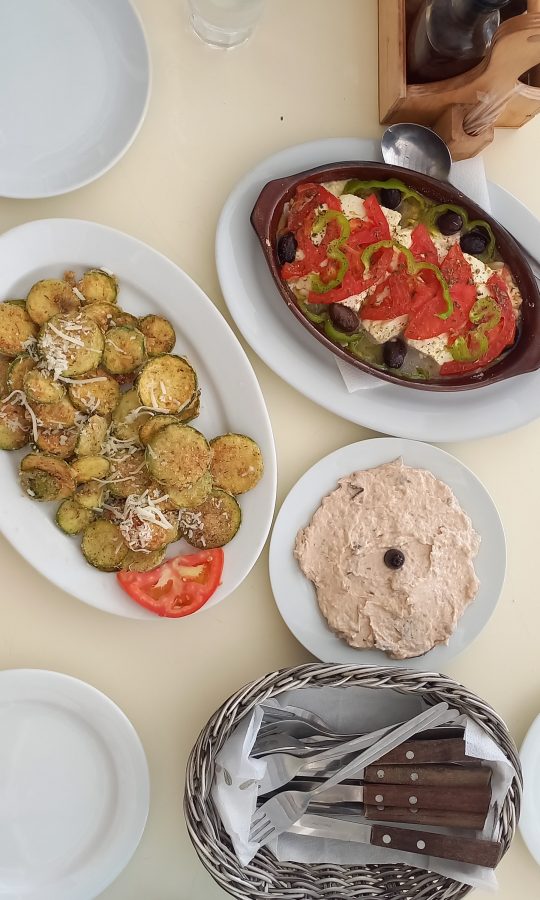
What You Eat (If You Want Cheap, Real, and Ridiculously Good)
This is the part tourists always misunderstand: Cretan budget food is not sad food. It is the backbone of the island.
If you want the best value, choose dishes that Crete has always done well, long before tourists arrived with their “authentic experience” hats.
Look for:
- Ladera (green beans, okra, briam, peas, artichokes—whatever is in season)
- Gigantes (big beans baked in tomato sauce)
- Fasolada / lentil soup (yes, soup in Greece is not seasonal, it is emotional)
- Oven dishes (pork or lamb when it is the dish of the day)
- Omelet + fries (the budget champion, undefeated)
- Horiatiki (village salad can be a full meal when it is made properly)
- House wine (because bottled wine can be lovely, but your wallet does not need romance)
This is how locals eat. This is why locals live long enough to become suspicious old men.
The Fish Exception (And Why the Harbor Hurts Your Wallet)
Now, yes.
Fish is always more expensive. Not because restaurants are evil. Not because the sea is dramatic.Because fish is fish.
It is the one category where the center vs neighborhood difference shrinks… but does not disappear.
A neighborhood fish taverna will still usually be cheaper than the center—especially near Koules—because, near the Venetian Harbor, you are paying for the view, the location, the captive audience, and the assumption that nobody will come back to check.
In the neighborhoods, fish is still pricey, but it is priced for people who might actually return next week. That alone changes the entire relationship between your plate and your bank account.
How to Choose a Taverna Without Getting Played
You do not need a blog. You need eyes.
Avoid restaurants with a staff member outside recruiting you like a nightclub, menus that scream “tourist special,” places where nobody speaks Greek except the kitchen, and anywhere that looks too polished for no reason.
Choose places where the chairs are not designer, the menu is not an illustrated book in six languages, the staff looks like they have worked there since 2002, and the food arrives like it is feeding you, not performing for you.
Heraklion rewards people who move.
If you stay in the center, you will eat well, yes, but you will pay the center’s price for being easy.
If you do the five stops trick, you will eat like a local: cheaper, better, with zero theatre, and with the quiet joy of knowing you just outsmarted the tourist economy using public transport.
Which is, frankly, the most Cretan thing you can do without owning goats.
Για την Κρήτη και για κάθε τόπο που ακόμη αναπνέει.
Argophilia — Independent. Unaligned. Always listening.
(For Crete, and for every place that still breathes.)
