- Excavations at Papoura reach 75% completion
- Central chambers nearing full investigation
- Protective and conservation works are underway
- Public event in Heraklion on March 2
- Case heard at the Council of State on March 4
- Nationwide work stoppage by archaeologists announced
The Hill Is Still Speaking
While legal briefs are drafted and arguments sharpened for Athens, the soil on Papoura Hill continues to open.
According to the Ephorate of Antiquities of Heraklion, archaeological work at the circular monument has reached approximately 75% completion. The corridors and small peripheral rooms are largely investigated. The central spaces are nearly fully revealed, with one exception: a hollow discovered in the natural bedrock of the northeast chamber, still under careful study.
This is not a paused site. It is active. Methodical. Layer by layer.
The excavation team is working with a full crew. At the same time, emergency consolidation measures are underway. Masonry is being stabilized. Structures are protected with geotextile. Stone samples are being sent for specialized laboratory analysis.
The monument is not abandoned. It is being treated as something that matters.
Science and Silence
The Ephorate has also proposed temporary archaeological zoning for three mountain systems in the wider Pediada area, including the twin-peaked Papoura–Axi Kefali.
What has not yet arrived at the Service, however, are the geophysical and geotechnical study results conducted on the hilltop by the project owner and contractor. Those findings remain unpublished to the archaeological authority. In a case this sensitive, absence speaks as loudly as presence.
Development and the Red Line
The Municipality of Minoa Pediadas maintains that protection of the monument is a non-negotiable red line, even as development projects proceed in the wider area.
Mayor Vasilis Kegeroglou states that from the beginning, the municipality has supported full protection and promotion of the monument while seeking solutions that balance development with historical responsibility.
It is a careful sentence. One that recognizes both pressure and priority.
Because this is not just about stones.
It is about proximity — specifically, the planned installation of aeronautical systems in direct adjacency to the monument.
March 4 at the Council of State
On Wednesday, March 4, the case reaches the Council of State.
The appeal, filed by the municipality, citizens, institutions, and scientists, seeks the annulment of decisions that authorized aviation infrastructure near the monument.
This is not a technical dispute. It is a philosophical one. What does public interest mean? Who defines acceptable proximity? How close can “progress” stand to antiquity before it becomes an intrusion?
The Archaeologists Step Forward
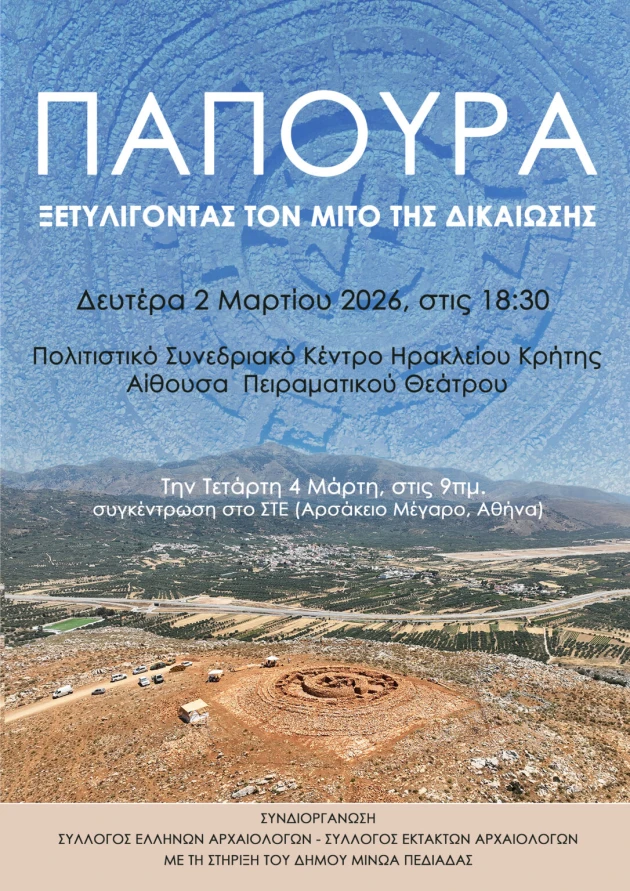
The Association of Greek Archaeologists and the Association of Contract Archaeologists are organizing a public event in Heraklion on March 2 titled:
“Papoura: Unraveling the Thread of Justice.”
They are also declaring a nationwide work stoppage and gathering outside the Council of State on the day of the hearing.
Their message is direct: Papoura is not merely a site. It is a test case.
A test of whether society retains a voice in what is preserved — and what is sacrificed.
The Hill and the Horizon
Seventy-five percent uncovered. Twenty-five percent is still beneath the earth. And a legal decision is waiting in Athens.
Papoura now exists in two timelines at once — one archaeological, measured in layers of soil and stone; the other judicial, measured in arguments and verdicts. The hill continues to reveal itself. The question is whether we are prepared to listen before the next installation comes into view.
