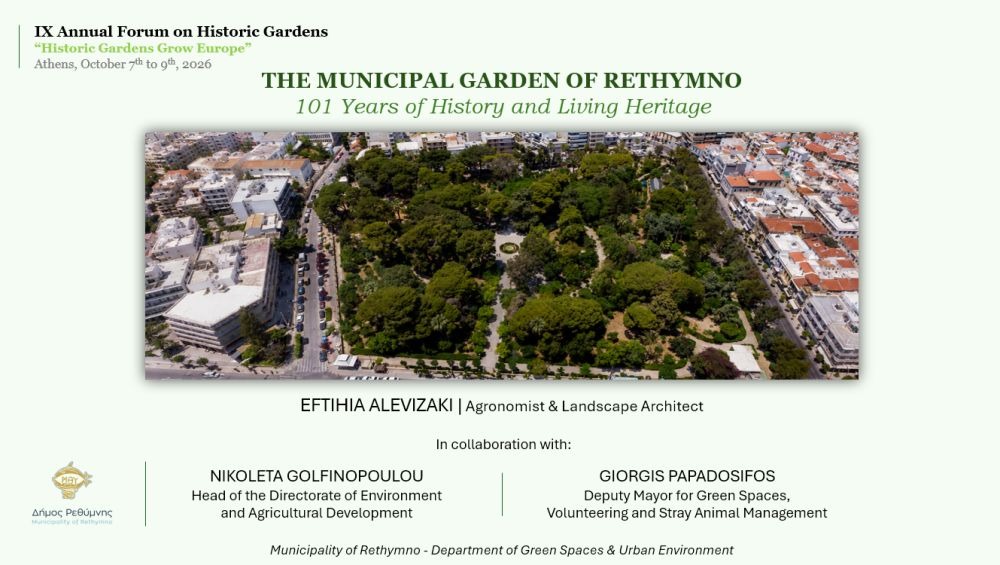
- Rethymno’s Municipal Garden was created in 1925 on the site of a former Ottoman cemetery.
- The historic garden covers 25,800 square meters in the city center.
- More than 130 plant species now grow there.
- Its history and future were presented at the IX European Forum on Historic Gardens in Athens.
While European experts discussed the future of historic gardens in Athens this month, Rethymno brought a strong example of its own to the table.
The city’s Municipal Garden was the subject of a presentation at the IX European Forum on Historic Gardens, held at Athens City Hall from October 7 to 9.
And unlike some conference subjects, this one has roots. Quite literally.
The garden was created in 1925, when the Municipality decided to protect a 25,800-square-meter area from development and transform it into a public garden.
The site was previously an Ottoman cemetery, making the garden’s history much older than its official 101 years.
More Than 130 Species Growing in the Heart of Rethymno
Today, the Municipal Garden contains more than 130 plant species and remains an important green refuge in the city.
It is also much more than a collection of trees and flower beds.
Over the past century, the garden has been part of everyday life in Rethymno, serving as a place for recreation, social encounters, and public life while becoming part of the city’s collective memory.
Historical documents and photographs presented at the forum traced the garden’s development and changes over the decades.
The Difficult Part Is Keeping an Old Garden Alive
Historic gardens have a problem that doesn’t fit neatly into a postcard. They have to remain alive.
That means protecting mature trees and historic plantings while addressing modern issues, including tree safety, changing environmental conditions, and climate change.
For Rethymno, the challenge is therefore not simply preserving what the garden looked like in the past. It is keeping the garden healthy enough to remain a functioning public space for the next generation.
The Municipality says it also hopes to connect the garden more closely with European networks dedicated to historic gardens and landscapes.
