The history of midye dolma, a dish of stuffed mussels, can be traced from Ottoman palace kitchens to Greek tavernas, then to the streets of Istanbul, where late-night vendors serve it to customers on the go.
Strolling through Istanbul’s old city late at night, one can find many types of street food to try. No tasting menu, no wine list, no reservation required. You can have as many stuffed mussels as you can eat in a single sitting. This is midye dolma, stuffed mussels, one of Istanbul’s most recognizable street foods.
While midye dolma is a typical Turkish street food today, its history is a lot more complex than that. According to the accounts of its development, the dish was first prepared by Armenian cooks in Istanbul, then by Greek cooks brought from Crete and Rhodes, by Greek tavern owners, in Ottoman palace kitchens, and finally by the Mardin migrants who took over the trade in the 20th century and brought the dish to its current form as a street food. The result is a dish with no single owner. And that may be the most Istanbul thing about it.
A Dish With a Greek Chapter
One of the most notable stories of midye dolma involves Greek cooks at the Ottoman court. In 1585, Sultan Murad III brought cooks from Rhodes and Crete to the Ottoman court in Istanbul. They were brought to prepare stuffed mussels for the Sultan and the palace, and palace records refer to them as gemismena mydia (stuffed mussels in Greek).
The Sultan also ordered the dish to be given away to the public. This is a great story and certainly deserves recognition, but like most historical food stories it requires some qualification. The 1585 reference is the firmer of the two accounts, while the earlier reference to the dish’s Ottoman origins is somewhat more uncertain.
While there is a story that Mehmed II ate stuffed mussels after the conquest of Constantinople in 1453, Hopwood-Phillips considers this to be a rumor, as almost every beloved Istanbul dish is said to have been eaten by the conqueror.
There is a more interesting story, though, which places Greek cooks from the islands at the heart of the Ottoman Empire, and Crete and Rhodes play a part in the history of the food that millions of people around the world now recognize as Turkish.
Before the Street Vendor, There Was the Kitchen
The modern version of midye dolma (stuffed mussel) is made by stuffing mussel shells with rice that has been seasoned with onions, pine nuts, currants, dill, allspice, cinnamon, and black pepper.
The rice is only partially cooked before being placed into the mussel. The shells are then closed, and the mussels are steamed. The rice will finish cooking while absorbing the briny flavor of the mussel. A squeeze of lemon completes the job. The combination is simple enough to look inevitable, but it wasn’t so to begin with.
Research into the culinary history of stuffed mussels points to the Armenian communities in Istanbul as early practitioners of the dish. The mussels were used as an affordable seafood and then stuffed with rice, pine nuts, and currants. Recent research into the development of Turkish culinary culture also points to Armenian and Greek communities as suppliers and transmitters of the stuffed mussel tradition.
This is where the history becomes more interesting than the question of who “invented” the recipe. Stuffed mussels were developed within the city of Istanbul, where different communities lived, traded, and learned from each other’s kitchens.
Why Mussels Made Sense
There was also a practical reason for the dish’s popularity. Mussels were inexpensive, plentiful, and compatible with fasting practices of Christian communities. The Armenian Istanbullites made use of mussels on many occasions throughout the year during times when Christians were forbidden to eat meat and dairy products. They used mussels to make a dish that could feed a whole family and even turn it into a business.
Food rarely develops from taste alone. Availability, religion, economics, migration and necessity all leave fingerprints on a recipe. The midye dolma has many of these characteristics.
The Greek Tavern Owners Who Kept the Tradition Going
The Greek connection did not stop with the cooks. Greek meyhane, or tavern, owners became part of the story, too. The taverns of Istanbul were closed during Ramadan, and because they depended on their regular customers, reopening was very important to them.
This account of a Greek tavern owner called “Barba” in Istanbul’s culinary history describes how he sent a boat-shaped tray of stuffed mussels to his favorite customers after his tavern’s Ramadan closure. It was as if he were sending a culinary calling card: his tavern was open again, and so was his food.
It is an unusually intimate detail in a food history. A restaurant reopening announcement, Istanbul-style, delivered on a tray of stuffed mussels.
From Palace Food to Street food
Over time, the preparation of midye dolma evolved from being made in kitchens and taverns to being sold on the street as street food. By the modern era, it had become a street food staple.
The mussels could be sold individually, the shells being opened for the customer, or stuffed with rice, currants, pine nuts, and lemon juice, and sold as ready-stuffed portions.
Turkish cuisine’s first published cookbook, Melceü’t-Tabbahin (1844), included a recipe for stuffed mussels. Another later version of the dish, described in Reşad Ekrem Koçu’s 1947 work, used mussels, rice, currants, and pine nuts to make a stuffed-mussel dish. By this time, the dish was already well known outside its original community.
Then Mardin Entered the Story
By the mid-20th century, migrants from eastern Türkiye had taken over most of the stuffed-mussel trade in Istanbul, particularly those from the city of Mardin. According to Hopwood-Phillips, by the 1960s, as Istanbul’s Armenian population declined, so too did the street trade in stuffed mussels, mostly taken up by new arrivals from Mardin; today, most vendors of midye dolma in the city are of Mardin origin.
There is a delicious irony here. Mardin is hundreds of kilometers from the sea. The migrants from landlocked Mardin became the people who sold Istanbul’s most famous seafood street food. The recipe changed along the way.
In terms of the dish’s adaptation to western Türkiye, academic research on the development of the stuffed mussel in this region describes how the older rice filling was changed by the Mardin migrants. The sweet combination of currants and pine nuts was replaced with a more heavily spiced rice filling. The dish had done what food does best: it moved.
Nobody Owns the Mussel
This might be the best way to make sense of midye dolma. It’s natural to wonder if the dish is Greek, Armenian, or Turkish. But the history gives a messier—and more interesting—answer: it belongs to all those cultures, but no single one owns it. Greek cooks from Crete and Rhodes contributed to the Ottoman tradition. Armenian cooks were key to shaping the recipe and passing it down.
Greek tavern owners brought it into Istanbul’s busy city life. Turkish families and cooks took it into their kitchens. Later, migrants from Mardin put their own spin on the street version, changing the flavors. In time, Istanbul made it a part of daily eating. The dish lived on because each group kept reinventing it.
The “Family Coat” of Istanbul Cuisine
Hopwood-Phillips compares the history of midye dolma to that of an old family coat which is handed down from one generation to another, each time altered slightly. It is a fitting image. The first owner is no longer known. Someone else repaired it, buttons were replaced by another person, and finally the coat was made to fit someone completely different. Then everyone began insisting it belonged to them.
That is how food history often works: recipes cross borders long before historians draw them.
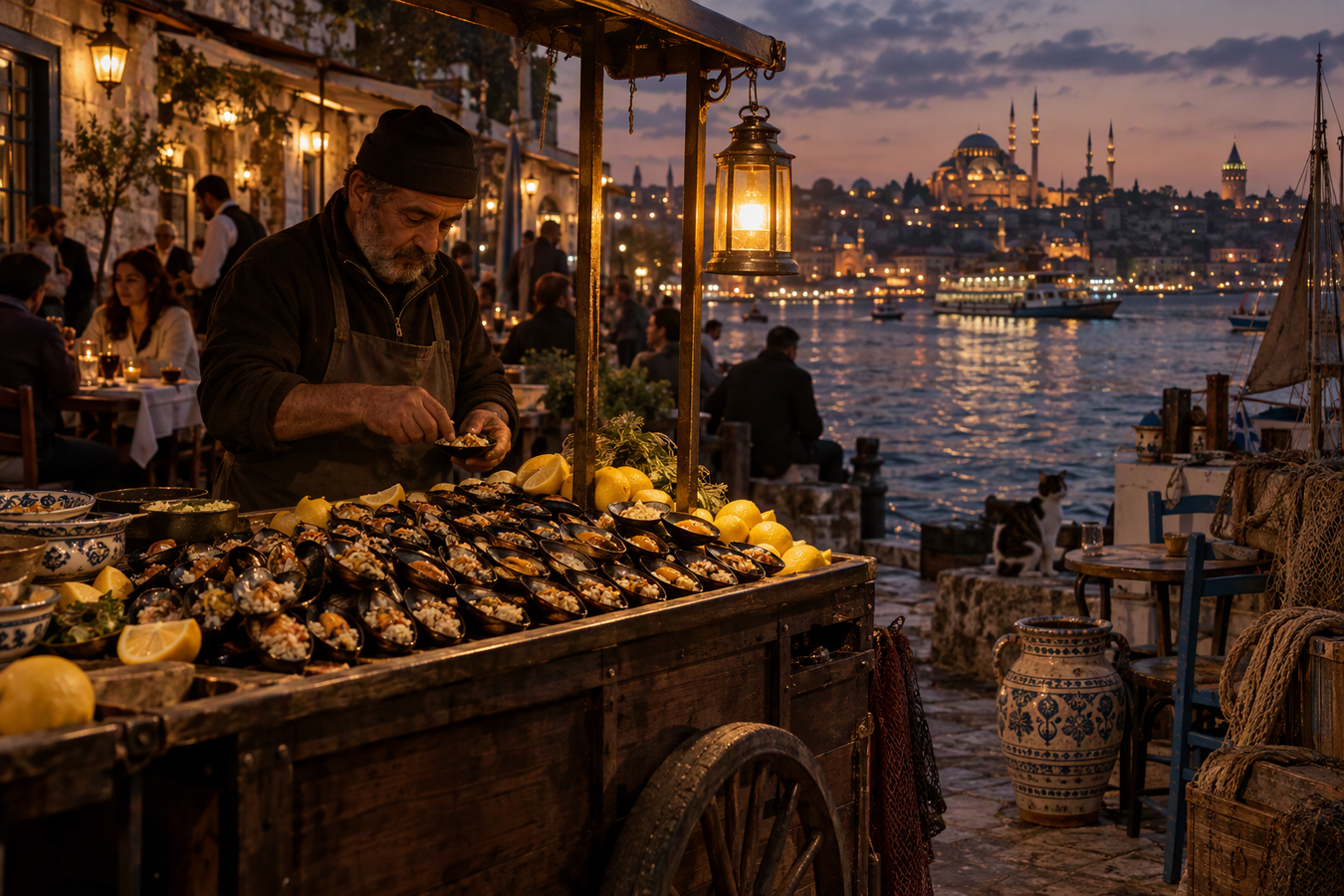
From Religious Necessity to 3 a.m. Street Food
Another transformation marks the story of midye dolma: what was once a practical food for religious fasting became one of Istanbul’s great late-night indulgences.
Today, vendors of midye dolma on the streets of Istanbul mostly sell them as single shells, handed out one by one with a slice of lemon. This lets customers eat as many as they like for dinner, as a snack, or as a terrible decision at three in the morning.
The city’s street-food culture has turned the mussel into something almost ritualistic. A person stops, buys one, then another, then realizes that the empty shells have accumulated into a small archaeological site. And this ritual is part of Istanbul’s identity.
Crete and Rhodes Are Still Part of the Story
For Greek readers, there is something special about learning that Crete and Rhodes are included in the historical documentation of a dish so strongly identified with Istanbul and Turkey today. This is also indicative of the wider Eastern Mediterranean. The sea has never been constrained by the borders which were subsequently drawn on maps.
People have traveled from island to island, port to port and city to city within empires. Cooks took techniques with them. Merchants took ingredients. Religious groups took recipes and adapted them to suit their own practices. Tavernas adapted them to suit their customers. Migrants then took them and adapted them further to suit their new economic conditions.
This rarely results in a neat, single-nation narrative. Rather, it is a culinary dialogue that unfolds over many hundreds of years.
The Dish Belongs to Istanbul Because Istanbul Made It
The best way to understand midye dolma’s role in Istanbul is to see it as the place where all these influences come together. Greek cooks brought knowledge from the islands, and Armenian cooks developed and preserved the dish within the city’s communities.
Greek tavern owners used it to maintain connections with customers, and Ottoman kitchens recorded and served it, while Turkish households adopted it. Mardin migrants reshaped its street trade, and modern vendors turned it into one of the city’s great edible rituals.
The stuffed mussel that reaches a customer on an Istanbul pavement is therefore carrying considerably more than rice. It carries migration, religion, trade, memory, and a few centuries of people refusing to leave a good recipe alone. And perhaps that is why trying to decide who owns midye dolma misses the point. The mussel was never really owned. It was passed around.
Original story inspired by NeaKriti’s coverage.
