The Greek Ministry of Culture is executing a comprehensive, multi-level development program exceeding €16 million to protect and promote Trikala’s rich historical continuity. The initiative aims to create a unified diachronic cultural axis in the city center, linking Ancient, Byzantine, and Ottoman monuments with modern museum infrastructure to boost local development, research, and tourism.
One of the most intriguing projects involves the Lycurgus Mosaic, a remarkable example of Roman mosaic art that is now being prepared for conservation and eventual return to the archaeological site where it was discovered.
The Lycurgus Mosaic returns to Ancient Trikki
The mosaic dates from the 3rd century AD and was discovered in 1958 by archaeologist Dimitris Theocharis at Ancient Trikki.
Its central composition depicts the myth of Lycurgus and forms part of a group of exceptionally important mosaic floors discovered at the site.
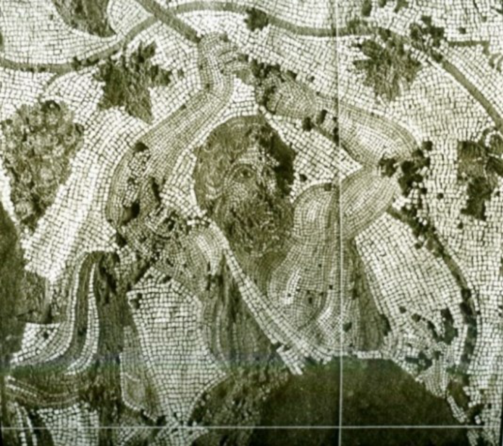
The mosaic was removed in 1978-79 for conservation and protection and has since been preserved in separate sections.
The Ministry of Culture has now completed the study for its conservation, restoration and reinstallation, with the intention of returning the work to the archaeological site.
At Ancient Trikki, which occupies a central position within modern Trikala, restoration and enhancement works are also underway to make the archaeological remains fully accessible to visitors.
Excavations during the 20th century uncovered remains including a Roman bath, a gymnasium, a Middle Byzantine church and a building decorated with elaborate mosaic floors depicting scenes from the Dionysian cycle.
The archaeological areas were brought together into the present archaeological site in 1995.
A new museum for Trikala
The largest individual project in the program is the creation of the Diachronic Archaeological Museum of Trikala in the former TΑΞΥΠ military complex at the foot of Profitis Ilias hill.
The project has a budget of more than €12 million and is being funded through the Thessaly Regional Operational Program 2021-2027.
The former military building was transferred to the Ministry of Culture in 2020, paving the way for its conversion into a modern museum.
The building will be repaired and upgraded to accommodate exhibition spaces, conservation facilities, storage areas, and visitor services. The permanent archaeological exhibition will occupy the first floor and will present the history and archaeology of Trikala across different historical periods.
The museum project has now entered the construction phase. In July, the Ministry approved the result of the tender process and announced a provisional contractor for the repair, modernization and conversion of the TΑΞΥΠ building.
The museum is intended to fill an important gap in the city’s cultural infrastructure. The Ministry has previously noted that Trikala is among the Greek regional areas without an archaeological museum, despite its exceptionally long history.
The Osman Shah complex
Another €1.95 million is being invested in the restoration of the Osman Shah mosque and mausoleum complex, which is currently at the stage of preliminary works.
The 16th-century complex is particularly significant because it is considered the only surviving work in Greece by the Ottoman architect Sinan.
The restoration includes architectural and structural work, lead roofing for the domes, lighting, electrical and mechanical installations, and the creation of a permanent exhibition inside the mosque.
Previous interventions have addressed structural stabilization, moisture and conservation issues.
A cultural route through Trikala
Together, the projects create something larger than a collection of individual restoration schemes.
Ancient Trikki and its mosaics, the Byzantine castle, the Osman Shah complex and the future archaeological museum will form a cultural network in the heart of Trikala, alongside attractions such as the Tsitsanis Museum and the restored Ottoman Double Bath.
The idea is to make the city’s history more visible and accessible while giving visitors a way to experience its different historical layers within a relatively compact urban area.
With more than €16 million being directed toward the projects, Trikala is making a substantial investment in turning its archaeological and architectural heritage into an interconnected cultural asset.
And for visitors, the most exciting part may be seeing the Lycurgus Mosaic back where it belongs, after almost half a century away from Ancient Trikki.
