There are still places in Greece where arrival feels less like reaching a destination and more like slipping through a crack in time.
Marathi, a tiny island scattered among the lesser-known reaches of the Dodecanese, is one of those places. Situated between Patmos, Lipsi, and Arki, this speck of land occupies little more than a third of a square kilometer. Depending on the season and which census one consults, its permanent population ranges from only a handful of residents to perhaps ten souls. In winter, the number can be counted on one hand. There are more goats than people, more boats than buildings, and more stars at night than most visitors have seen in years.
The journey is part of the experience. There is no airport, no ferry terminal handling large vessels, and no queue of tour buses waiting to disgorge crowds. Most visitors arrive by small boat from nearby Arki, a journey that takes only a few minutes but feels much longer psychologically. The mainland world of schedules, traffic, deadlines, and notifications begins to recede almost immediately. As the boat approaches the island’s sheltered bay, the first impression is not one of luxury but of simplicity. Whitewashed rooms, fishing boats bobbing gently on crystal-clear water, a handful of tavernas, and a sandy beach tucked into a natural harbor create a scene that seems untouched by modern tourism.
Marathi offers none of the amenities travelers have come to expect from Greece’s famous islands. There are no beach clubs pumping music into the night, no designer boutiques, no rental cars, and no sprawling resorts. In fact, there are no roads at all. What the island offers instead is increasingly rare in the Mediterranean: silence. Not complete silence, of course. There is the wind, the sea, the occasional goat bell, and the murmur of conversation drifting from a taverna terrace at sunset. Yet compared to the noise of modern life, Marathi feels almost monastic.
Most days unfold according to a rhythm that has changed little in decades. Guests wake to the sound of water lapping against the shore. Breakfast is taken overlooking the bay. The remainder of the morning might involve swimming, reading, snorkeling, or doing absolutely nothing at all. On larger islands, visitors often feel pressure to see and experience everything. Marathi encourages the opposite. The island’s greatest attraction may be its refusal to provide a checklist.
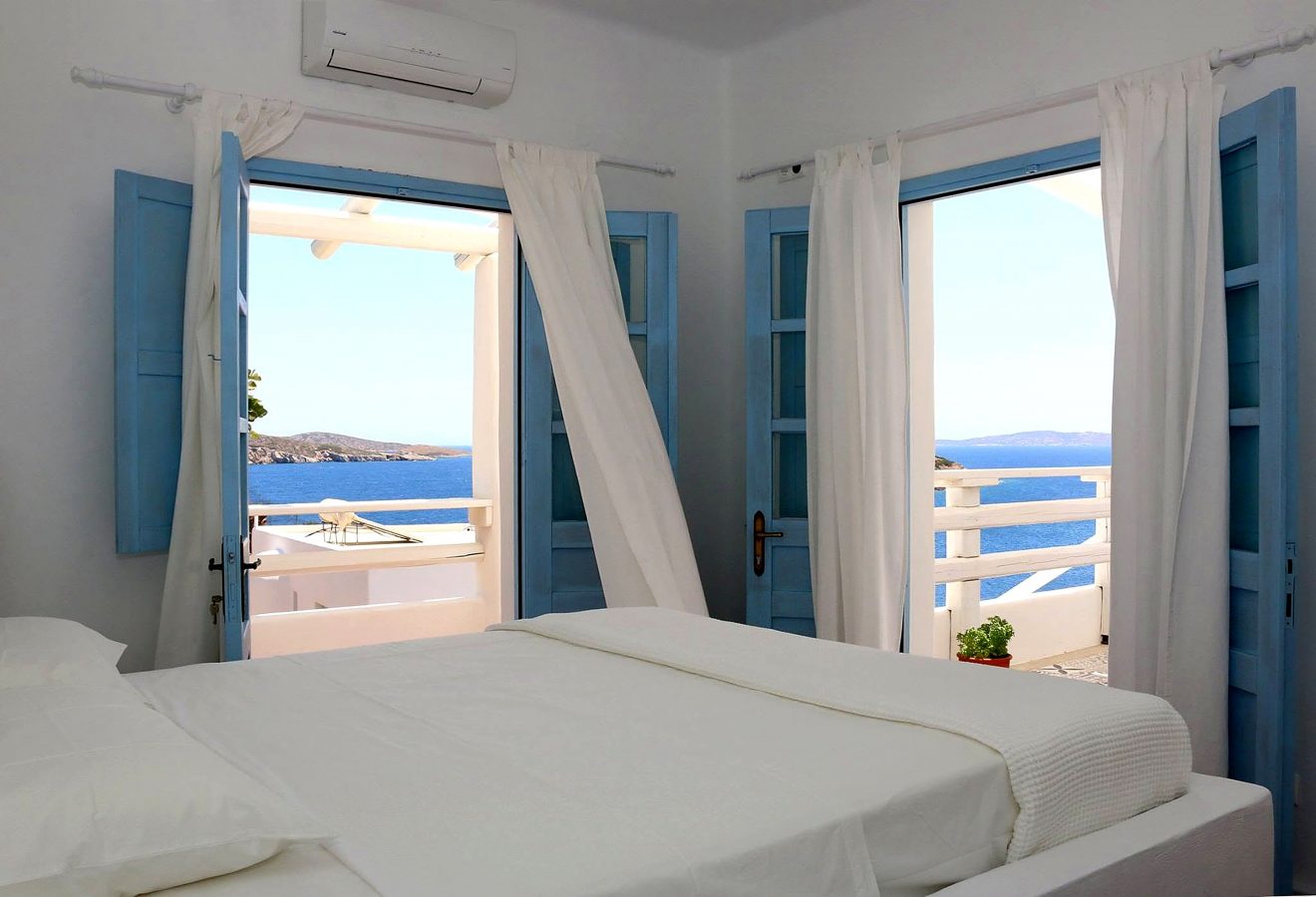
Accommodation on Marathi remains refreshingly limited, helping preserve the island’s tranquil character. Visitors can choose from the well-known Pantelis Marathi Island Resort, a family-run property overlooking the bay, the smaller and more traditional Marathi Rooms, or one of several private rental homes collectively known as the Marathi Houses (image above), including the House of Love, House of Life, and House of Light. Rather than large resorts or boutique developments, these modest accommodations reflect the island’s simple philosophy: comfort, authenticity, and an intimate connection with the sea.
The waters surrounding Marathi are among its greatest treasures. Protected by neighboring islets and natural formations, the bay remains calm even when stronger winds sweep across the Aegean. Yachts frequently anchor here, drawn by the island’s reputation as one of the most peaceful moorings in the Dodecanese. The sea itself is astonishingly clear, shifting from pale turquoise near the beach to deep sapphire further offshore. For swimmers and sailors, it is difficult to imagine a more inviting setting.
Yet perhaps the island’s greatest luxury is not its scenery but its perspective. From the small church overlooking the bay, visitors can gaze across a landscape largely unchanged by mass development. There are few places left in Europe where one can stand atop a hill, look in every direction, and see almost no evidence of modernity. The view is not dramatic in the way of Santorini’s caldera or Crete’s rugged gorges. Instead, it possesses a quieter beauty rooted in scale, simplicity, and isolation.
Marathi will never compete with Greece’s headline destinations, nor should it try. It belongs to a different category altogether. This is an island for readers, sailors, dreamers, and those who occasionally find themselves wondering what life looked like before the world became so relentlessly connected. It is a place where time slows, conversations lengthen, and sunsets become the day’s principal event.
In an era when even remote destinations are increasingly discovered, photographed, geotagged, and transformed into social media backdrops, Marathi remains refreshingly indifferent to trends. It asks very little of its visitors beyond a willingness to slow down. For many, that may prove to be the greatest luxury of all.
Getting There
Part of Marathi’s charm is that reaching it requires a little effort. Most travelers begin by flying to Leros or Samos, or by taking a ferry from Piraeus to Patmos. From there, regular ferry and boat connections link Patmos, Lipsi, and Leros with the nearby island of Arki, the closest inhabited island to Marathi. The final leg is typically made by small excursion boat, water taxi, or private vessel from Arki, a journey of only a few minutes across crystal-clear Aegean waters. During the summer season, day boats also operate from Patmos to the Arki-Marathi island group. Visitors should allow flexibility in their schedules, as weather conditions occasionally affect local boat services.
