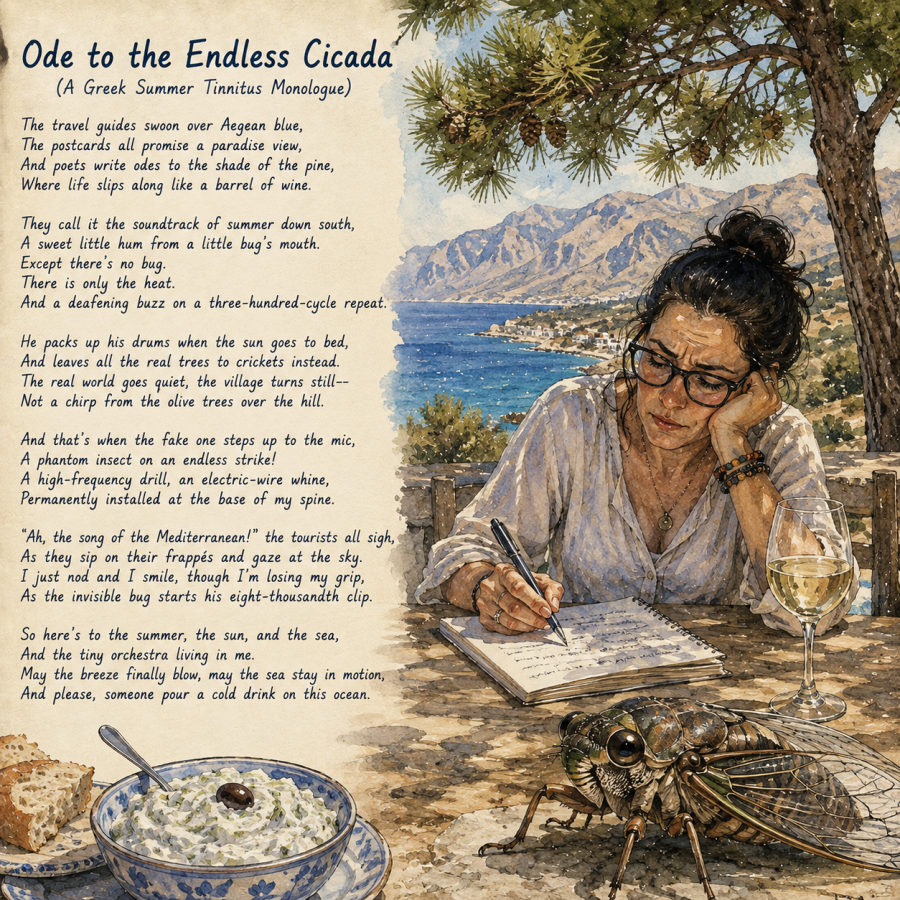
I have spent this season writing love letters to this island. This is not a love letter. This is a formal complaint.
Let me set the scene. It is two in the afternoon on a terrace somewhere in Crete. The light is honey-colored, the sea is a rumor of turquoise below, a glass of cold white wine is sweating on the table. It is the postcard. And over all of it, from every olive tree within a kilometer, comes a sound like a power tool arguing with a jet engine.
The cicadas are singing. Again.
The Greeks have an expression for unbearable heat: “skai o tzitzikas,” the cicada bursts. I used to find it charming. Then I learned the cicada does not burst. The cicada thrives. The cicada is, at this very moment, optimizing.
Because here is what the scientists will tell you, and what no travel brochure ever will: a single cicada can produce 80 to 100 decibels. A dense chorus at close range peaks at 110 to 120 and beyond. For reference, that is a lawnmower, a chainsaw, a rock concert, a low-flying jet. I did not pay for a flight to the Mediterranean to stand, unprotected, in the front row of heavy machinery. And yet here I am, living every day, at lunch, at the beach, in the shade of the very trees I chose for shade.
And let us be precise about what is happening, biologically. The singers are the males. They produce the noise with special abdominal membranes called tymbals, and they sing to attract females. So the situation, in plain terms, is that half the population is screaming at the other half at chainsaw volume, and the other half is not even applauding. It is the worst dinner party in the Mediterranean.
Worse still, they are engineers of their own acoustics. Cicada orni, the signature species of the Mediterranean, behaviorally regulates its body temperature, shuttling between sun and shade to keep itself at exactly the right heat to sing. Do you understand what that means? There is no moment when they are too hot to perform. They are sunbathing while screaming. They have climate control. I, sweating through my linen shirt, do not.
And if you were hoping the heat would eventually end them—no. The folk expression wishes them to burst; the biology declines. Climate change, that great amplifier of everything, is making my tormentors punctual, expansive, and possibly longer-serving. Warmer springs bring an earlier first song; long-term data from Japan show males emerging and singing sooner as temperatures rise. Mediterranean species like Cicada orni are already pushing north into Spain. Scientists are solemnly asking whether a warming climate will change when, where, and for how long we hear the cicadas’ song. I can answer that from personal experience: always, everywhere, and forever.
Even fire does not evict them. The nymphs live underground for years, feeding on the sap of tree roots, so a burned forest’s bill comes due slowly; the cicadas outlast the trees, outlast the news cycle, outlast my patience. They are the last guests to leave any party and the first to arrive at the next one.
Meanwhile, the poets call this “the soundtrack of the Greek summer.” The travel writers swoon. The postcards mention it fondly. I would like to formally commission a poem about tinnitus.
A Field Guide to Silence
And yet. I have spent the season hunting quiet across this island, and I have found it repeatedly. So for those of you who love Crete but cannot love its amplifier, here is my hard-won survival guide:
Follow the wind. Cicadas hate strong wind. The south and southwest coasts, Elafonisi, Falassarna, Plakias, catch the Meltemi and the afternoon breezes that keep the chorus down. There is a particular joy in lying on pink sand and hearing, instead of chainsaws, actual waves.
Choose barren ground. Cicadas need trees to feed and lay eggs. Avoid the dense olive groves and pine forests at peak hours; go to the arid, rocky coasts, or climb above the tree line, where the mountains are silent in a way that feels almost illegal.
Walk the stone, not the leaf. City centers are quieter than you think: Chania’s Venetian Harbor, Heraklion’s waterfront—fewer trees, less volume. The cicadas cannot sing what they cannot perch on.
Own the morning. They are ectothermic; they need the sun to switch on. Before nine or ten, the island is blessedly, astonishingly quiet. I have started drinking my coffee like a local with a secret: the morning is the only honest hour.
Surrender the afternoon. Their peak is the hottest window, one to five, the same window in which the island wisely invented the siesta. Museums, air-conditioned lunches, closed shutters, a book. The Cretans were not napping out of laziness; they were negotiating with the cicadas.
Trust the dusk. They stop entirely at sunset. The Cretan night is cicada-free; the evening belongs to crickets, waves, and conversation. Every day ends in amnesty.
Fortify the room. When booking, look for double- or triple-glazed windows; modern soundproofing erases the high-frequency drone. Run the AC with the windows shut; its white noise masks what the glass misses.
Arm the ears. Standard foam earplugs struggle with high frequencies. Pack high-fidelity acoustic earplugs, Loop, Alpine, or active noise-canceling headphones. I now travel with mine the way other people travel with sunscreen.
And to conclude, I give you:
Ode to the Endless Cicada
(A Greek Summer Tinnitus Monologue)
by Mihaela Lica Butler
The travel guides swoon over Aegean blue,
The postcards all promise a paradise view,
And poets write odes to the shade of the pine,
Where life slips along like a barrel of wine.
They call it the soundtrack of summer down south,
A sweet little hum from a little bug’s mouth.
Except there’s no bug. There is only the heat.
And a deafening buzz on a three-hundred-cycle repeat.
He packs up his drums when the sun goes to bed,
And leaves all the real trees to crickets instead.
The real world goes quiet, the village turns still—
Not a chirp from the olive trees over the hill.
And that’s when the fake one steps up to the mic,
A phantom insect on an endless strike!
A high-frequency drill, an electric-wire whine,
Permanently installed at the base of my spine.
“Ah, the song of the Mediterranean!” the tourists all sigh,
As they sip on their frappés and gaze at the sky.
I just nod, and I smile, though I’m losing my grip,
As the invisible bug starts his eight-thousandth clip.
So here’s to the summer, the sun, and the sea,
And the tiny orchestra living in me.
May the breeze finally blow, may the sea stay in motion,
And please, someone pour a cold drink on this ocean.